
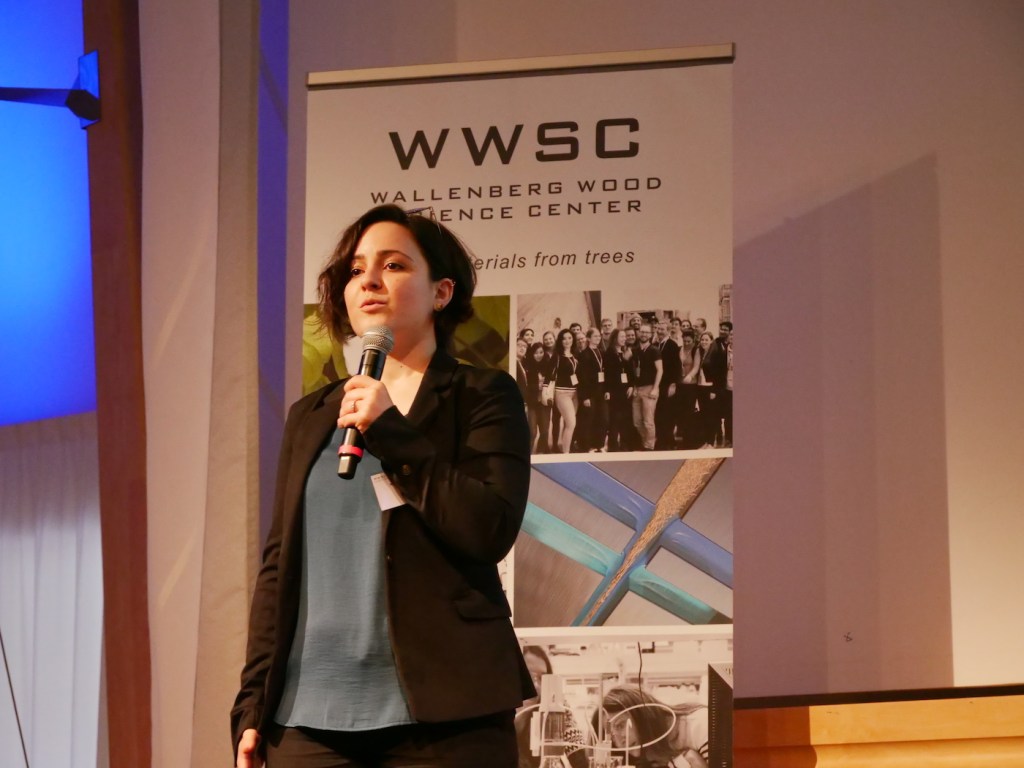
Ioanna Sapouna is a PhD student in our group. She has been working within a national network called the Wallenberg Wood Science Centre (WWSC), and is part of the WWSC PhD Academy. Ioanna defended her doctoral thesis at KTH Royal Institute of Technology on June 14th 2023.
Hi Ioanna! Huge congratulations on the completion of your PhD, it is such an achievement! How do you feel now that you have cleared this milestone?
Thank you so much Lauren! It took me a while to realise yet that it’s over! I am glad I made it and I am trying to digest the fact of graduating as the days pass.
For those who are not working in the Swedish university system, can you tell us what happened on the day of your PhD defence?
It was a great day! In the morning, the defence started with a presentation from my opponent Prof. Claudia Crestini, who gave a short presentation about my work and showed how it fits in the lignin chemistry field. After that, I presented my work. This was followed by a discussion with my opponent on my thesis work – I must say, I enjoyed that part. The faculty committee asked questions next. I was honoured by having Assistant Prof. Mika Sipponen, Prof. Ola Wallberg, and Prof. Monika Österberg as my committee members. That was the public part of the defence. After that, the committee privately discussed and decided that I passed the exam. The announcement was held at the WWSC workspace, in front of my colleagues, friends, and family who were there with me. Quite an emotional moment! After the defence I had lunch with the committee and a party in the evening. It was a real celebration!
We always try to make sure that dissertation events are meticulously planned, but was there anything that surprised you on the day?
In the PhD defences at KTH, there is always someone from IT helping set up the webinar, making sure the electronics are working, and so on. All worked fine up to the moment the presentations started! PowerPoint suddenly stopped changing slides during Prof. Crestini’s presentation and my pointer stopped working during my presentation. That was a bit stressful in the moment but thinking about it now it might have actually helped dissipate the tension. Also, at some point the lights randomly turned off, probably because of a timer or something like that, and one of my committee members said “Oops! Time’s up!” That was funny and helped me relax a bit.
Let’s talk about the research you performed for your PhD. What was the overall goal of your thesis?
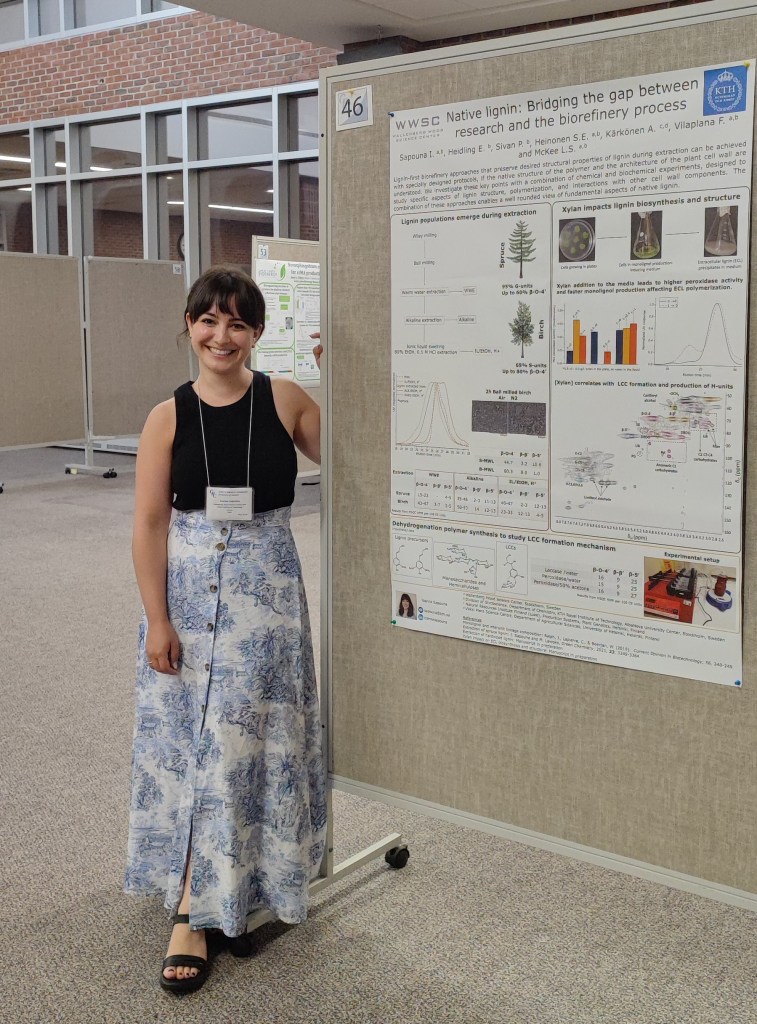
The overall goal was to explore fundamental aspects of native lignin, such as its structure, polymerization and interactions with the other components of the plant cell wall. I’ve written about some of the published work that went into the thesis in blog posts here on this website 🙂
Do you feel like you answered all the research questions that you wanted to address? Or are there some aspects of lignin structure and synthesis that still really make you curious?
Many of the topics I explored have been controversial for several decades now. We tried to come closer to answering some of the bigger questions and I believe our work did make a small contribution towards that goal. Of course, there are more aspects to be explored and questions to be answered, and if I could continue this research for four more years, I would still have a lot to do! However, I am happy with the work we have done and everything I learnt these past years.
What was the most surprising thing you found out during your research these past four years?
It is quite common in the field to talk about lignin heterogeneity and how the structure of the polymer is very different from plant to plant, and even between different parts of the same plant. This is true. For example, if you are trying to find repeating units in lignin or a specific sequence in its building blocks, it’s not going to happen. But, at the end of the day, “lignin is just lignin”. Its precise structure and properties might depend on different parameters but when we analyse it we are considering averages of the different structures we find in the plant, so the impact of extraction for example turns out not to be that pronounced. It might seem logical now, but it was a big moment of realisation for me looking at all of my data and expecting to see bigger differences between samples.
PhD students at KTH need to take a lot of courses during their programme, and you also took part in the PhD Academy Programme offered by the Wallenberg Wood Science Centre, which financed your work. Was it ever challenging to balance your time between research and courses? If so, how did you manage that?
Absolutely it was! (laughing) You can plan your experiments and be very well organised but one of the most important things my studies taught me was that experiments can really go sideways. When this happens, which is absolutely fine by the way, you can wave your schedule goodbye! In these situations, it was really hard to also handle all my other responsibilities, for example maintaining certain lab equipment, or attending the courses and workshops of the Academy. But you learn something from every situation. Prioritisation is the only way to manage. I needed a lot of help with this, especially in the beginning, but I think I got better at it. Also, getting used to budgeting time for things to go wrong helped me! It might sound strange or even pessimistic, but many times I struggled with an overloaded schedule and having ‘spare’ time allotted to repeat failed experiments really helped.
And what do you think is the most important skill you have gained during your doctoral studies?
As I had no prior experience with lignin chemistry before my PhD, each project was a step out of my comfort zone. Due to certain events along the way, there were times where I felt I was stepping further and further away. If I have to choose a favourite skill, I would say NMR analysis. I absolutely loved working with this technique. But a PhD is not only about technical skills. For example, I also learnt how to adapt to different situations and overcome difficulties that I couldn’t even imagine before I started.
Is there anything you will miss about this period in your life?
This was the last time I held the title “student”. I will continue learning throughout my career, but the “official” part is over. If you think that for the largest part of my life I’ve been studying, it is a big change. I am not sure I will miss it, but definitely it will take some time to adjust.

If you were able to go back in time and tell yourself something to make you better prepared for the PhD journey, what do you think it would be?
“It is OK to fail”. This was the most important lesson of my doctoral studies. Experiments occasionally fail, planning doesn’t always work out the way you thought – not to mention about bigger changes and situations completely out of your control. Starting my PhD with the mentality that things don’t always go the way you thought they would be could have made things a bit easier to handle.
Ok, let’s look to the future now. It has been a couple of months since you defended your PhD, so what are your next steps?
I would love to continue my journey in research and preferably continue working with lignin. And I just had a baby! So after maternity leave, I plan to do a post-doc in the lignin field and I would like to focus on material applications. I feel that during my PhD I got a broad, theoretical background on lignin and now I want to apply this knowledge and do something more tangible.
What are you looking forward to the most?
There have been so many changes in my personal and professional life the past few months that I don’t even know where to start! The coming months will for sure be exciting and I want to be open to all the different experiences coming up.
Finally, do you have any words of advice for future PhD students at KTH or other universities?
I’ve heard this before from another PhD student and I truly felt it during my studies: If you are not certain about pursuing a PhD, don’t do it. There are ups and downs throughout these years that will challenge you in every way possible. I don’t think I would have made it if I didn’t really want this. But if you decide to go for it, then try to experience all the high highs and the low lows because four years go by surprisingly fast!
Thank you Ioanna for the interview, and for all the hard work over the past few years. We will miss you at KTH, but we know you are moving on to bigger and better things – we can’t wait to see what you can achieve!!

 Stockholm CAZyme Lab
Pingback: Year in review – 2023 | Stockholm CAZyme Lab