
Category Archives: Behind the paper

Collaborative work to understand lignin properties and promote applications of native-like lignin

Over the years, many different protocols have been developed that enable lignin extraction from biomass, each aiming to acquire high yields while maintaining certain characteristics. The structures obtained from an extraction make the polymer useful either in specific industrial applications or for research purposes, such as to understand the fundamental structure of native lignin. The native composition of lignin varies depending on several parameters, such as the plant species. As a result, it is considered challenging to develop one universal protocol for lignin extraction that works for all types of biomass, ensuring the same lignin yield and structure. In work published in 2021 in Green Chemistry (https://doi.org/10.1039/D0GC04319B) we developed a protocol that enabled us to study the impact of a popular mechanical pre-treatment, known as ball milling, on the extractability and structure of lignin from softwood (spruce). Even though I used mild conditions throughout the sequential extraction protocol, I could extract almost 85% of the lignin in the wood, in contrast to classic protocols with typical yields up to just 50%. With detailed characterization of the lignin size and structure by size exclusion chromatography and nuclear magnetic resonance spectroscopy, we got insight into the architecture of the plant cell wall and hypothesized on what is happening to its polymers during ball milling, on a supramolecular level.

To further explore lignin extractability, we have now applied the same general mild protocol to obtain lignin from ball milled hardwood (birch), as described in our recent publication in ACS Sustainable Chemistry & Engineering (https://doi.org/10.1021/acssuschemeng.3c02977). Softwood and hardwood species differ in cell wall composition, so the extraction of biopolymers is considered to need a different approach for each type of wood. If I compare my own data on extracting lignin from a softwood and a hardwood, using this sequential extraction protocol, I actually see rather similar trends in terms of the impact of ball milling time and atmosphere on the lignin extraction yield. In this new hardwood study, we used a technique called pyrolysis GC-MS to look more closely at the impact of each step in the extraction process. Hardwood lignin has two major building blocks (units), whereas softwood lignin just has one, and we observed a preferential extraction of one specific lignin unit from the hardwood in certain extraction steps. Knowing this gives some clues as to how an extraction process might be designed to target specific lignin structural characteristics. In addition, with this protocol we got the opportunity to study some lignin-carbohydrate complexes of ether and ester type in some fractions, an excellent opportunity to discuss the nativity of these still controversial bonds. It was interesting to see that the order in which certain extraction steps were applied did not greatly affect the yield or the structure of the lignin fraction we obtained. This suggests a strong influence from the solvent system, pH, and temperature used, which, again, can inform the development of protocols that target lignin for specific applications such as surfactants and antimicrobial coatings. It also indicates that we may not yet fully understand the impact of, say, ionic liquids or acid, on intact wood biomass, as the effects of changing parameters would then be more predictable.

Lignin fractions obtained from hardwood lignin and their main characterization methods. 

In order to showcase the potential for using lightly modified or “native-like” lignin in material applications, we used the fractions extracted from softwood and hardwood to prepare lignin nanoparticles (LNPs), a popular form of biomaterial being explored around the world for a range of uses. In this work recently published in Industrial Crops & Products (https://doi.org/10.1016/j.indcrop.2023.117660) we saw that the morphology of lignin nanoparticles depends on several parameters. These include the concentration of lignin, the polysaccharide content in the lignin fraction used, and the inherent chemical properties of lignin, such as its molecular weight, β-O-4’ content, lignin unit composition (S/G ratio), and hydroxyl content. There are many implications on the colloidal stability of these nanoparticles suggested by the aforementioned parameters that a more in-depth characterization of their formation mechanism might look into. LNPs are today typically formed from so-called technical lignins, a residue of the pulp and paper industry, and are being explored for a plethora of applications such as sunscreens and small molecule encapsulation. A variety of different techniques have been developed for LNP formation that offer high control of their properties and morphologies. However, our proof-of-concept study investigated the applicability of lignin fractions that come from milder lignin-focussed targeted extractions, using a green solvent system and a very simple setup. By using a ‘cleaner’ kind of lignin, we could control the experimental setup very well and analyse a number of parameters of LNP formation at the same time. Our nanoparticles also seem to be pretty stable, giving further support to the idea of using mildly extracted fractions in industry.

Morphologies of lignin nanoparticles from softwood and hardwood, native-like lignin. 

I am very happy that these publications derive from collaborative efforts. The project on lignin extraction from hardwood included important contributions from Gijs van Erven from Wageningen University in the Netherlands, who brought not only his expertise on pyrolysis GC-MS, but also insightful ideas on data interpretation. Also, results from the Master’s thesis of former KTH student Emelie Heidling were included in the extraction paper. Being involved in Emelie’s supervision was an important experience of my doctoral studies. I found it to be challenging and occasionally stressful, yet rewarding and extraordinary at the same time. Closely following and having even the smallest impact on the educational development of another person made me more confident that teaching is a career that I would love to follow.

The LNP project was a collaboration with Alexandros Alexakis, a materials scientist and expert in latex nanoparticles formation, and Eva Malmström Jonsson, the current director of the Wallenberg Wood Science Centre. Alexandros was a WWSC PhD student at KTH in my graduating cohort, and is now a post-doc at Stockholm University. I truly enjoyed this collaboration as it combined our independent efforts in our respective “comfort zone” fields and enabled me to learn new methods as I became more familiar with techniques that I had only briefly used in the past. Following the different approach Alexandros was taking on data interpretation and reflecting on our discussions made me realise that understanding material properties is not only about technical characterization. An important aspect is digging deeper into understanding the interactions between the components of a material and their role in structure-property relationships.

Having two more collaborative projects during my doctoral studies that led to successful publications is in itself rewarding. By bringing together diverse expertise and approaches, collaborations create results that may not have been possible from individual effort, and they also promote personal development and networking. I am looking forward to what the future holds, and I hope more collaborations are included!
Enzymatic deconstruction of complex carbohydrate cell walls in the soil

A Polysaccharide Utilisation Locus from Chitinophaga pinensis simultaneously targets chitin and β-glucans found in fungal cell walls. Lu Z*, Kvammen A*, Li H, Hao M, Bulone V, McKee LS. mSphere 8 (2023) e00244-23 *Authors contributed equally and share first position

I have been scientifically obsessed with bacteria from the Bacteroidetes/Bacteroidota genus for a long time. Even when I have spent time researching diverse other topics like sterol metabolism, potato pathogens, cell wall synthesis, and lignin structure, I keep coming back to work on these brilliant bacteria.

The Bacteroidota are a dominant group in the microbiomes of essentially every ecosystem where complex carbohydrates (glycans) are found – this includes the human gut, the rumen, the soil, and the ocean. They thrive in these diverse ecosystems despite difficulties like high competition from other species or low substrate concentration making it hard to grab nutrients. They do so well because they have certain adaptations that enhance their survival fitness. First among these has to be the Polysaccharide Utilisation Loci in their genomes, which we generally refer to as PULs.

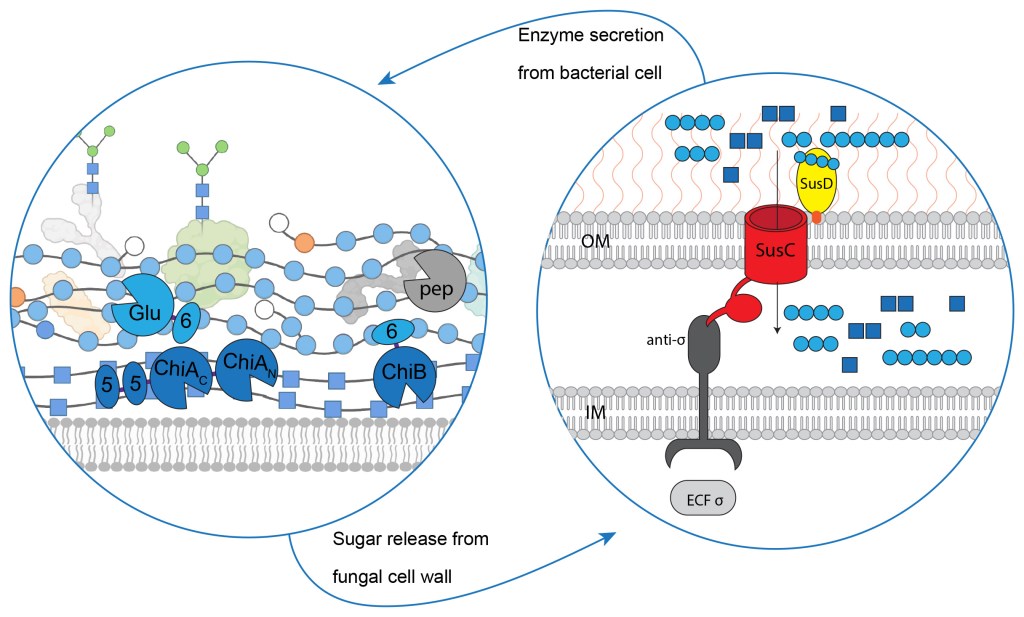
As has been written in a number of excellent reviews and book chapters (including some that I have contributed to), a PUL is a discrete contiguous set of genes that encode the protein elements a bacterium needs to metabolise a certain glycan. On the outer membrane of the cell, we find a pair of proteins called SusC-like and SusD-like proteins – these work together to recognise specific glycan structures and bring them into the periplasm (the space between the outer and inner cell membranes). The glycan brought into the periplasm gets recognised by a protein on the inner membrane, which sends a signal to the DNA. This leads to a major increase (upregulation) of gene expression for all of the genes in the PUL. Importantly, this includes genes encoding enzymes that can work together to deconstruct the activating glycan into sugars small enough to be brought into the cell and metabolised.

This system is extremely elegant. And it is an effective energy-saving tool. Many of the enzymes that are used by bacteria to deconstruct complex carbohydrates are large modular proteins, and they often have to be secreted outside of the cell to reach their substrate. This is an energy-expensive process, and it would be wasteful to secrete big enzymes if their substrate were not available. So including these genes within a PUL means that the enzymes only get produced when their substrate is present. Neat! In many cases, researchers have suggested that PULs give bacteria a competitive advantage over other species as it lets them grab onto substrates and hoard them so other species can’t access the nutrition. Rude!

The first PUL to be studied was the now-canonical Starch Utilisation System (SUS), in the lab of the incredible Prof Abigail Salyers. Examples have since been characterised that target polysaccharides as diverse as chitin, xyloglucan, xylan, mannan, and more. These PULs share a number of features – they all have the SusC-like and SusD-like outer membrane proteins, gene expression is activated by the glycan substrates of the PUL, and the enzymes encoded act synergistically to degrade that glycan. This past summer, we published an article that showcased a PUL that I find interesting because it breaks this trend just a little bit, by encoding enzymes that target two different polysaccharides. Like many of my recent and ongoing enzyme discovery projects, this PUL was first identified as a target for characterisation in a paper I published in Applied & Environmental Microbiology in 2019 (https://doi.org/10.1128/AEM.02231-18), in which I announced that my favourite bacterium is and will always be Chitinophaga pinensis.

A figure showing our hypothetical model for how the Fungal Cell Wall Utilisation Locus works. Taken from our publication in mSphere, see https://doi.org/10.1128/msphere.00244-23 for the full paper.

Our new paper was published in mSphere in July 2023 (https://doi.org/10.1128/msphere.00244-23). The first author on the paper is Zijia Lu, who did a 60-credit Master’s thesis project in my group as a guest student from Uppsala University. Zijia was incredibly productive during her entire time in the lab and had already published two other articles that included her work (published in FEBS Journal and mBio). Her main goal for her thesis was to explore enzymes produced by Chitinophaga pinensis that may be involved in degrading or attacking the cell walls of fungi or oomycetes, principally the cell walls of plant pathogenic species. The idea was that, if we could find enzymes that attack pathogen cell walls, we may be able to use C. pinensis as a biocontrol weapon against plant disease. But first, extensive biochemistry was called for.

The PUL we were looking at encodes three enzymes, all of which contain both catalytic domains (glycoside hydrolases, GHs) and non-catalytic domains (carbohydrate binding modules, CBMs). We looked at the protein sequence and family annotation of all of these domains, then tried to produce them in different combinations to understand their activities. One enzyme (CpGlu16A) was predicted to be able to hydrolyse beta-glucans, and carried a CBM we predicted would bind the same glycan – and those predictions were right! When a CBM binds to the same polysaccharide as its enzyme partner is hydrolysing, we tend to see that the enzyme works better and/or faster, because it sticks to its substrate for longer. This was also the case for another enzyme in the PUL (CpChiA), where the GH domains were predicted to hydrolyse chitin and the appended CBMs predicted to bind chitin. Again, the predictions were accurate. Zijia did a huge amount of work to understand these enzymes, but an annoyingly persistent global pandemic broke out while she was visiting family in China, so things were put on hold and ultimately the project was not completed by the time Zijia had to submit her thesis.

In October 2021, our lab was joined by Alma Kvammen, a powerhouse Research Engineer who always had the energy to jump into new projects. She helped us complete a lot of different initiatives, including Zijia’s PUL. The third enzyme in the PUL (CpChiB) was intriguing – we correctly predicted that the enzyme domain would hydrolyse chitin, while the CBM would bind to beta-glucan. As you would expect, this means that the CBM gives the enzyme no advantage in hydrolysing chitin. But we must always remember that, in nature, polysaccharides do not exist as isolated purified molecules – they exist embedded within highly complex cell wall matrices. Chitin and the kinds of beta-glucan our enzymes are targeting are found specifically in fungi, and we think the PUL we characterised most likely targets intact fungal cell walls. Earlier work had shown how enzymes targeting pectin or hemicelluloses in plant cell walls can be made to work more effectively on intact plant biomass if they are attached to cellulose-binding CBMs, and we think our beta-glucan-binding chitinase is an example of the same phenomenon!

The last key element that defines a PUL is that its enzymes should work synergistically to break down the substrate. Alma prepared a fungal cell wall extract from button mushrooms (Agaricus bisporus) to see how the enzymes behaved when mixed together. The extract was a highly condensed material, due to the preparation process, and so enzyme accessibility was probably quite low. This meant that the release of reaction product by the enzymes was also low. Nonetheless, Alma was able to show that the enzymes do a better job of breaking down the fungal cell wall when they work together, rather than when they are alone. So all in all we are confident in saying that the Fungal Cell Wall Utilisation Locus (FCWUL) fulfils all the criteria of a classical PUL, except that it can target a more complex substrate. Next step is getting back to Zijia’s initial question – can these enzymes work together to kill a fungus? That might be a question that runs over several Master’s thesis projects…

Zijia Lu now works at EnginZyme in Stockholm, Sweden, while Alma Kvammen is working at ArcticZymes in Tromsø, Norway. Two brilliant enzymologists and biotechnologists, productive and professional in every way.

Lignin interactions with its environment

The impact of xylan on the biosynthesis and structure of extracellular lignin produced by a Norway spruce tissue culture. Sapouna I, Kärkönen A, McKee LS. Plant Direct 7 (2023) e500.

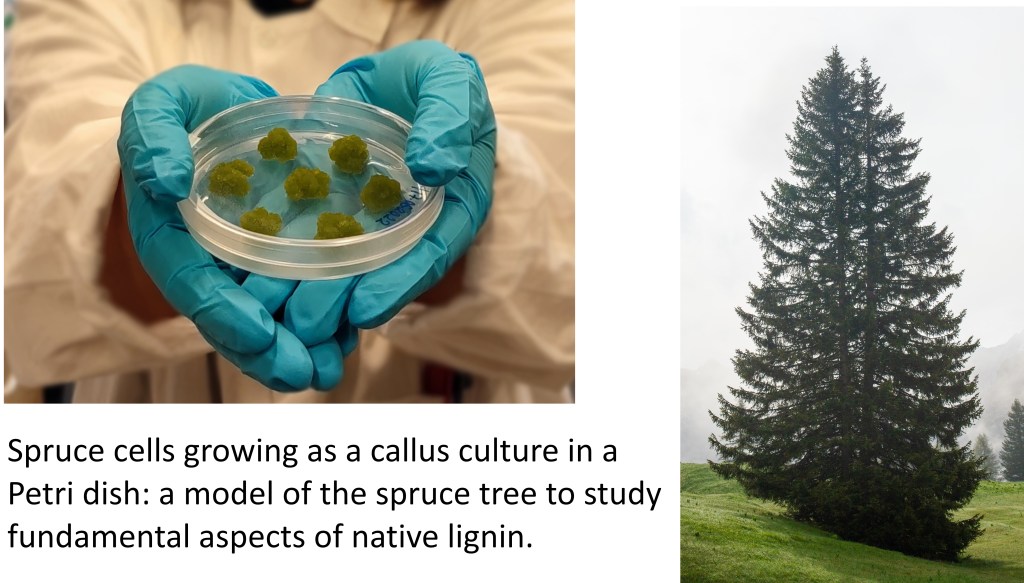
What does a spruce tree growing in a forest have in common with a few spruce cells growing in a Petri dish at KTH? At first sight, the differences are striking as the two systems seem to only share the same colour. Biologically speaking the two systems are indeed different, even though they share the same genome. For example, in the woody tissue, the lignin building blocks or monolignols, enter into the secondary plant cell wall, an environment of cellulose and non-cellulosic polysaccharides known as hemicelluloses, in which they form the lignin polymer.

By contrast, in the callus culture, the cells do not form a secondary cell wall and they do not produce monolignols. It is however possible to induce monolignol production by transferring the spruce cells from the agar plates they grow on into cultivation flasks with liquid medium. In this changed environment, the cells do secrete monolignols into the liquid medium, and these polymerize to lignin extracellularly. The key advantage of this model callus culture system is that lignin polymerizes outside of the cells, which means that we can collect it by a simple filtration step. Normally, in order to isolate lignin from woody tissue, extensive mechanical pre-treatments and extraction steps are required and these are known to alter the structure of native lignin and destroy the architecture of the plant cell wall. However, understanding the real chemical and physical interactions between lignin and its polymerization environment is an important step towards utilization of lignin, which until now is a major waste of the pulp and paper industry.

In our recently published study in Plant Direct we used the Norway spruce callus culture to understand the structure of native lignin and its interactions with a component of its natural polymerization environment, a hemicellulose named xylan (Sapouna et al., Plant Direct, 2023, 7, e500, doi.org/10.1002/pld3.500). Although similar studies have been performed on purely chemical systems, in which monolignols are introduced in a solution that contains an enzyme and the hemicellulose, the final structure of synthetic lignin is not very similar to the native one. We used several cultivation treatments in which xylan was added in different concentrations in the cells’ solid growth medium and/or in the monolignol polymerization liquid medium, and we found that the cells do indeed react differently in the presence of xylan. Even though there was no change in the morphology of the cells, i.e. the cells did not start forming a secondary cell wall, there was an increase in extracellular lignin production and the activity of an enzyme necesary for lignin polymerization, in the treatments with added xylan. Also, there were small changes in the structure of lignin in these treatments, which I studied by extensive NMR to understand the bond composition and SEC to determine the molecular weight.

This project, which started in 2019, was quite outside of my “being a chemist” comfort zone. In the beginning it was challenging to even learn how to keep the cells alive. Three years later, I was able to handle many samples at the same time and subculture about 80 plates in one day, every three weeks.  Challenging projects are great opportunities to expand one’s knowledge and skills. As a chemist, I look at a reaction or synthesis and focus on the chemical properties of the reagents to understand the system and improve it, but there are many more variables in experiments that work with living tissue. Working on this project made me look at lignin from a different perspective. I came closer to understanding its biosynthesis and realized how sensitive and versatile the process can be. To decipher the structure of native lignin and its interactions with the other cell wall components, it is necessary to understand how lignin is produced and the simple parameters that can affect this process. It is when we fill in the existing knowledge gaps about the fundamental properties of lignin that we will be able to utilise it to its full potential, as a major product of the wood biomass.  

Collaborations in a PhD student’s life

During a meeting, conference, workshop, or coffee break, a brilliant idea sometimes shines in the restless mind of a PhD student. Looking into it and trying to formulate a good plan to work on it, the student realizes that some aspects are way outside of her field of knowledge… and there is not enough time to become an expert in all scientific fields. This realization will undeniably lead the student to ask for help and hopefully, a collaboration will begin. As with any experiment, a collaboration can be fruitful and lead to high-value results which add to our understanding of the world. If things are not managed well however, an attempted collaboration can mean the end of a professional relationship, or even the abandonment of a project altogether. It’s all a matter of communication! Being clear about the expectations on everyone involved is a key ingredient of a successful collaboration. This has been an important lesson for me to learn at the beginning of my career, as I have had the opportunity to bring collaborators into my own projects and also had the chance to contribute to others’ work.

There are different degrees of involvement in a collaborative project. A seemingly simple or “small” contribution for me could be performing a short series of characterizations and the corresponding analyses. Such a seemingly small experiment, which might be quite easy for the person doing it, can generate data that are pivotal to a certain publication, yet contributions like this often go unrecognised. This leads to ethical issues such as people not being given credit for their work. It is a very fulfilling experience to have your intellectual work recognised as an actual contribution to a study, and the guidelines of the International Committee of Medical Journal Editors are very helpful in defining who should be listed as an author. I am happy and honoured to have recently been included in publications deriving from three interesting projects to which I contributed lignin characterization by using nuclear magnetic resonance experiments and size exclusion chromatography. These are methods I am familiar with, but they take time and expertise to both perform and interpret.

In the first collaboration, published in the journal Cellulose (Ghaffari et al., Cellulose, 2023, 30, 3685–3698, doi.org/10.1007/s10570-023-05098-8), lignin diffusion through a cellulosic membrane was explored.  A diffusion cell was used as a model to study what happens during delignification of pulp. The success of this process depends on the effective diffusion of lignin through a cellulosic matrix, and this project aimed to understand the parameters that govern and can affect that process. The diffusion cell used in this study was equipped with a cellulosic membrane, and lignin solutions were provided on one side of the cell membrane. The impacts of lignin alkalinity and size were investigated by varying the pH of lignin solutions and the molecular weight of the lignin fraction used.

Molecular weight of lignin and pH of solution affect diffusion of lignin through a cellulosic membrane. Figure from Cellulose, 2023, 30, 3685–3698. doi.org/10.1007/s10570-023-05098-8.

By performing a series of characterizations of the chemical properties of lignin in the donor and acceptor solutions, i.e. the solutions on each side of the cellulosic membrane, we could conclude that low molecular weight of lignin and high pH of the solution can increase diffusivity. This was attributed both to changes in the conformation of the polymeric structure of lignin and in the membrane itself. For example, high pH is known to reduce self-association of lignin, making it easier to diffuse through smaller pore size. We also found that alkalinity increases the porosity of the membrane, by swelling of cellulose. The results of this study can be used in the optimization of pulping to improve the yield and efficiency of the processes.

Next, two publications showcase the amazing properties of wood aerogels. The paper published in Advanced Functional Materials (Garemark et al. Advanced Functional Materials, 2023, 33 (4), 2208933, doi.org/10.1002/adfm.202208933) described the formation of a wood aerogel that can to be used as a power generator, by harvesting the hydrovoltaic energy produced during water evaporation. Wood samples were treated with sodium hydroxide at -6 °C, which led to the partial dissolution of the polymeric components of wood that diffuse to the empty lumen. Then, the dissolved polymers precipitated with the addition of water and formed a network of fibrils in the lumen. This re-distribution of the wood structure offers several advantages to this application. For example, the surface area of the material is increased, so there is an increased evaporation at the water-air interface. In a very cool demonstration of this technology, these wood power generators were connected in series and used to power a digital timer (https://onlinelibrary.wiley.com/doi/full/10.1002/adfm.202208933, see Supplemental Video 1).

Wood aerogel formation for harvesting hydrovoltaic energy produced during water evaporation. Figure from Advanced Functional Materials, 2023, 33 (4), 2208933, doi.org/10.1002/adfm.202208933.

The second application we demonstrated, published in ACS Nano (Garemark et al. ACS Nano, 2023, 17, 5, 4775–4789, doi.org/10.1021/acsnano.2c11220), was of a shape-memory wood aerogel. Polymeric shape-memory aerogels can be used in a variety of applications as insulators, actuators, or sensors. Currently they are mostly made of fossil-based materials and produced via complicated methodologies. As a result, this new wood-based application opens the way to sustainable development in this field. The wood aerogels are prepared by a one-pot treatment of wood samples with an ionic liquid and dimethylsulfoxide. There is a partial solubilization and redistribution of the wood components, as in the previous material. Upon the addition of water that leads to their precipitation, a fibrillar network is formed inside the lumen. Importantly, lignin is not severely modified during this process, and only a small degree of bond cleaving was observed, showing that ‘native’ or unmodified lignin has real technological applicability. The still-high lignin content in the aerogel, and the redistribution of the polymeric materials after solubilization and precipitation, is thought to be the cause of the excellent mechanical properties of the aerogel, which are in the same range as wood itself.

Participating in the above projects was an exciting experience as I was given the opportunity to discuss the relation of my own more “theoretical” lignin research in the context of specific material applications. My PhD thesis will discuss the importance of advanced knowledge of the native lignin structure, and how that can help design sustainable lignin-related processes and materials, and these works are important demonstrators of that concept. It is always nice to discuss with enthusiastic colleagues about cool projects and share your passion about your own research field. It is also a great accomplishment to use the skills that have been gained during your studies to contribute to others’ work, so I encourage all PhD students to talk to their supervisors about the potential for collaborative participation. I am looking forward to more collaborations like these.