Category Archives: Progress

Welcome interview: PhD student Carlos Huertas Diaz

Carlos Huertas Diaz is a PhD student in our group. He started at KTH in September of 2025, and his work is mostly funded by the Swedish Research Council Vetenskapsrådet. Lauren McKee is his main supervisor, and he is co-supervised by Francisco Vilaplana at KTH and Johan Larsbrink at Chalmers University, Gothenburg.

Hi Carlos, and welcome to Stockholm! Congratulations on starting your PhD programme at KTH! You finished your Master’s degree just before summer and now you’re a doctoral student – how does it feel so far?

Hi Lauren! Thank you so much for this opportunity first of all. It feels unreal: I had literally just finished defending my Master’s Thesis and a few minutes later I got the offer of this PhD position, perfect timing! It’s a huge step in my career and a big challenge, but as we have talked about, I really want to keep learning and further researching, and this is just the perfect opportunity. So far I’ve felt super welcomed, the people at the Glycoscience Division feel like family already and this creates such a nice working environment where I can totally be myself.

What has been the biggest challenge or the most unexpected thing since you started at KTH?

Honestly the most challenging part was finding an accommodation, since I had no clue that Stockholm had such a high demand for housing and you had to be registered for queues before. And now being an employee that is still also a student: that has been a big transition from only being a student, where this is a total new environment and with much more responsibilities and where the start point feels different from being in a class with many other students (where everyone is as lost as you), to sharing an office with people working on many different things (where everyone is still lost, but lost individually). However, it feels very enriching to get to know about all these new topics. 

What are you most looking forward to in the coming four years?

I am so ready to learn more and be able to develop myself as a researcher! I wanted to continue studying because I still feel I have the motivation and I would really like to implement this knowledge at the same time, so a PhD was just perfect for these characteristics. It will for sure be a great challenge and with ups and downs, but I really want to dive deeper in research and be able to join the scientific community. Apart from that, traveling and exploring different facilities and working environments is something I would really like to do and I believe it can be very fulfilling, where you can meet great scientists who shape you and teach you along the way! I’m looking forward to my first conference next spring, and I hope we can plan for at least one research visit for me somewhere.

And is there anything you are particularly nervous about?

I am a bit nervous about publishing and writing manuscripts, since it’s new for me and as a mandatory part of the PhD it’s something I have respect for. I see it as a complicated process, where I will give my best to do as great as possible. I thought that I would be nervous about teaching and supervising Master students, but now I am feeling quite optimistic and looking forward to it. I think it will be real fun.

You are working now in the Division of Glycoscience, and there’s a lot to learn about carbohydrates and how we analyse them! Tell us a bit about the research project you are going to be working on.

In this project we will be working on the discovery, characterization, engineering and the application of carbohydrate-active enzymes (CAZymes) of microbial origin. We are aiming to explore the diversity of these enzymes encoded by industrial and environmental microbes. The main goal is to understand their activities and stability, exploring their application for industrial processes. Many recent studies propose that non-catalytic appended accessory domains such as the carbohydrate binding module (CBM) can stabilize CAZymes, but this is not really confirmed or understood, so we will test these hypotheses. For this project we are aiming to understand these inter-domain interactions and the stabilizing effects on the CAZymes so that stable industrial biocatalysis can be achieved.

Your previous research experience was at Lund University and before that in Spain. What was the difference between working in those two places? And how do you think KTH compares so far?

In Spain I did my Bachelor’s Thesis at the Center of Molecular Biology Severo Ochoa (CBMSO) in Madrid under the supervision of Aurelio Hidalgo. Then in Lund, Javier Linares-Pastén supervised my Master’s Thesis in the Biotechnology Division of the Engineering Faculty (LTH) of Lund University. They were both amazing experiences where I could settle myself into research. The main differences I would say were the authorship scale, where in Spain the gap between students and researchers or principal investigators is greater than the one in Sweden, where I felt professors were more easily approachable and students have more freedom of creativity in their project. Moreover, in Lund the facilities of the Kemicentrum, where I was performing my thesis, were more updated than the ones in CBMSO, so of course it was more accessible where the most resources were present. Here at KTH I see it so far as very similar to Lund University, with a super friendly and uplifting environment, where I can see myself improving as a researcher with great facilities and infrastructure.
A few short questions to get to know you…
What is your favourite kind of food? Empanada (I think the translation would be meat pie).
Do you prefer to read books or watch movies?  Movies, but a good book is always better.
What is your favourite animal?   The galaxy frog.
What is the best advice you’ve ever received? I live with this quote in my mind “journey before destination” where someone added “but in company”.
What skill would you most like to learn?  Further understanding mass spectrometry or nuclear magnetic resonance would be very cool.

Thank you Carlos for telling us about yourself – we are so glad to have you join the team!!

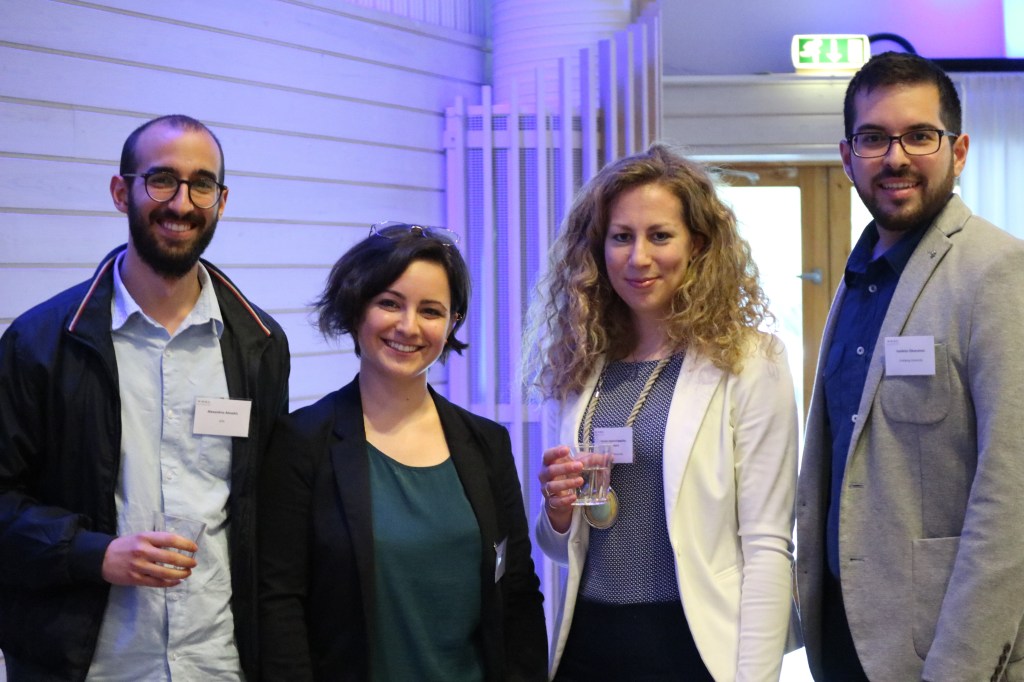
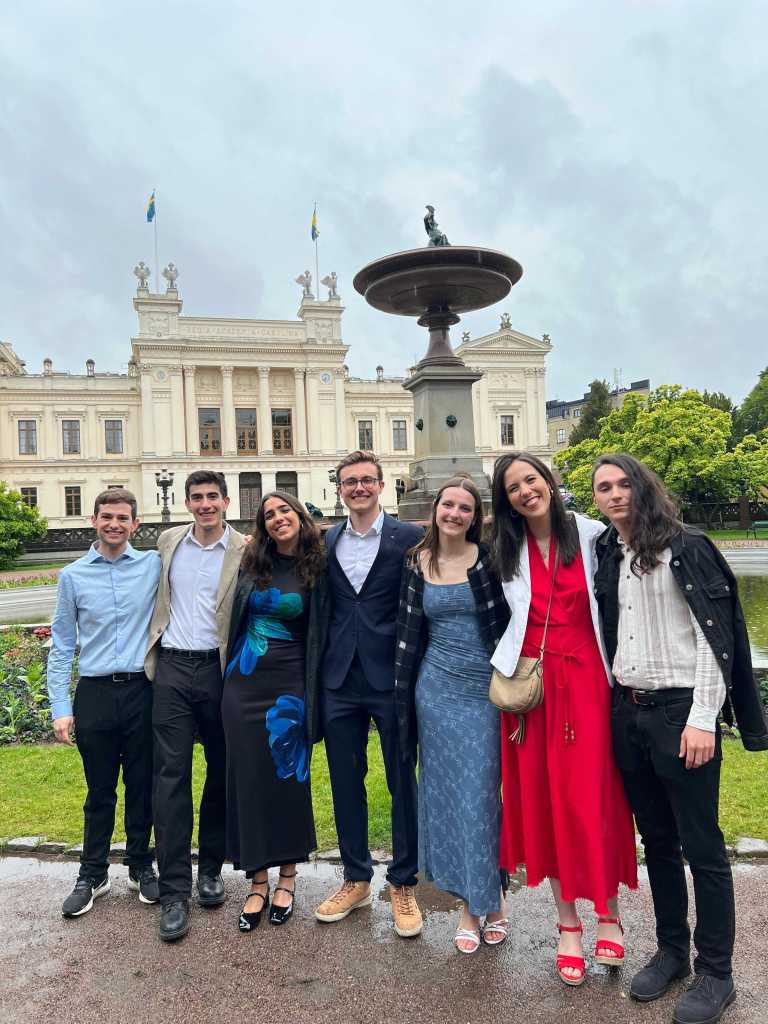
Group photo with Carlos and the rest of Lauren’s team  at AlbaNova (Carlos: I love this picture!).

Half-time evaluation seminar: A KTH milestone for Pakinee as PhD student

When I just started my PhD in 2023, I was very excited to be surrounded by a new environment, new systems, new people, and, most importantly, to enter my new role as a PhD student. I had a lot of fun in the first months with several trips, social activities, and also learning new things. However, there has always been one thing that I have never felt comfortable with, even before my PhD started. I never enjoyed any task that involved giving a presentation in front of a group of people. I am kind of a nervous person when I have to give an oral presentation and feel many eyes staring at me.

One of the presentations I was most nervous for was the half-time evaluation seminar that all PhD students at KTH CBH School must do after completing half of their PhD work. The goal of having a half-time seminar is to reflect on what I have done over the past two years such as how many course credits I have completed so far, how much I have progressed on my research, and importantly to see if I will be able to successfully exit the PhD programme on-time as a graduated student (of course, I don’t plan to quit the PhD).

As we have a 4-year PhD programme at KTH, most of us present their half-time seminar after about two years. It is undeniable that time flies so fast… Suddenly, somehow, two years have already passed since I arrived in Stockholm, and the time for my half-time evaluation was knocking at the door. While preparing for my evaluation, I had the chance to pause and reflect on myself. I found that two years in the PhD role was changing me. No, no, don’t worry! I don’t mean that it made me bipolar or gave me depression… In contrast, this role shaped my strength and made me more mature in my character. For example, I feel more comfortable to communicate openly, especially in sharing my opinion and seeking for help when I have a problem. Moreover, I feel more confident in giving presentations such as at Glycoclub, which is our every-Friday group meeting, because I have received warm support from friends, colleagues, and my supervisor.

In addition to changing in my character, two years of working as a PhD student have changed my way of thinking as well. For example, I no longer see scientific publications as just a cool thing I can achieve. Instead, I recognise that the outcomes of my work can provoke promising new applications that have a meaningful impact on the environment and society. Moreover, I also stopped viewing myself as just a pair of hands in the lab producing data day after day; I began to see that I could teach and transfer my knowledge during teaching and supervision of other students, and I could inspire younger generations interested in science. Because I work alongside other PhD students and have attended a few conferences, I can also see myself as a member of scientific community, which starts to feel really good.

After this reflection on myself, I also took time to properly reflect on my research. When you are busy doing experiments and trying to keep up with many deadlines, it is easy to be so focussed on the details that you forget the big picture. I realised that I have produced good results in my research, and it was definitely enough for the half-time presentation. So, my results were ready to be evaluated…but I myself was not. I didn’t want to believe that I had already finished my second year, and I was going to become a third-year PhD student. There are many things I still want to do and things I want to learn, and just two years left seems not enough. I realised that I had planned to take too many course credits, and I will have to cut some of them out to make sure I have time for my research. But this contrasts with my feeling that I still want to take more courses and gain more new knowledge!

While preparing the 10-page report and 30-min presentation for the half-time evaluation, honestly, I felt tired and a bit stressed about having to do it, and I knew I didn’t want to embarrass myself. It was going to be a big day for me and my supervisor. I needed to prepare well and push myself to get through it. I thought to myself, how can I reach my defence and achieve an academic position in the future if I already feel so frustrated with this half-time seminar! With that feeling, I jumped out of bed, turned on my laptop, and started writing.

On the day of the seminar, I was happy to see many familiar faces from the Glycoscience and Industrial Biotechnology groups. I felt a lot of support from the audience and I felt happy that many people were interested to listen to my talk. Well, I started my presentation with less nervousness than usual. I was surprised that I actually presented better than when I had practiced at home. Although I had less nerves than I expected, the 30-min speaking time still felt like an eternity. I now truly understand how tiring it must be for teachers who give a two-hour lecture… After finishing the presentation, the evaluators were kind and asked reasonable questions. They were both professors from other departments at KTH, with expertise in sequencing technologies and polymer recycling. Most of their questions focused on the challenge of designing industrial applications and how my work is relevant to address current issues of waste disposal in the Swedish pulp and paper industry. Their questions emphasised that what I was doing is something valuable and meaningful. Furthermore, some questions were very useful to help me identify gaps I missed or I hadn’t noticed before.

After the presentation and Q&A session, it was a time for evaluation, so the audience was asked to leave the room. There was only me, my co-supervisors, the two opponents, a director of third-cycle studies, and of course, my awesome supervisor. Alone in the room with them, I felt like there was a group of grey clouds flying around me and above my head. I totally had no clue what would come next… But then the clouds start fading away when one of the opponents said my Individual Study Plan (ISP) was the best that she has ever seen. It felt like the sun came out and I could relax again. Next, the director of third-cycle studies said the overview of my PhD project was great and made her understand easily what I was doing. These words felt like a huge compliment that killed the anxiety I felt before. During the evaluation, there were no more questions about my academic knowledge or my research. We mostly talked and discussed about my study plan, the structure of supervision I receive from Lauren, and my ability to handle the work still to come and to achieve the PhD. In the end, I got evaluated to pass the half-time. What a relief!

After my half-time evaluation, I felt proud of myself. I go through something that I wasn’t looking forward to, and I did it better than I expected. From this, I learn that I should not underestimate myself and I should be more confident in my ability to perform. Undeniably, I now accept I am a third year PhD student. Time is running out. I must do what I still need to do to create myself as a potential researcher that others would want to hire and work with in the future. There is still so much I want to learn but now I can see more clearly what the next two years will look like, and I can see the progress I have made already. My next milestones for this year are finishing some more courses, supervising a project student, and submitting my first research paper to a journal. I’m feeling hopeful for the next two years but I am really glad that the half-time evaluation is over now!!

Moving on: PhD student Ioanna Sapouna

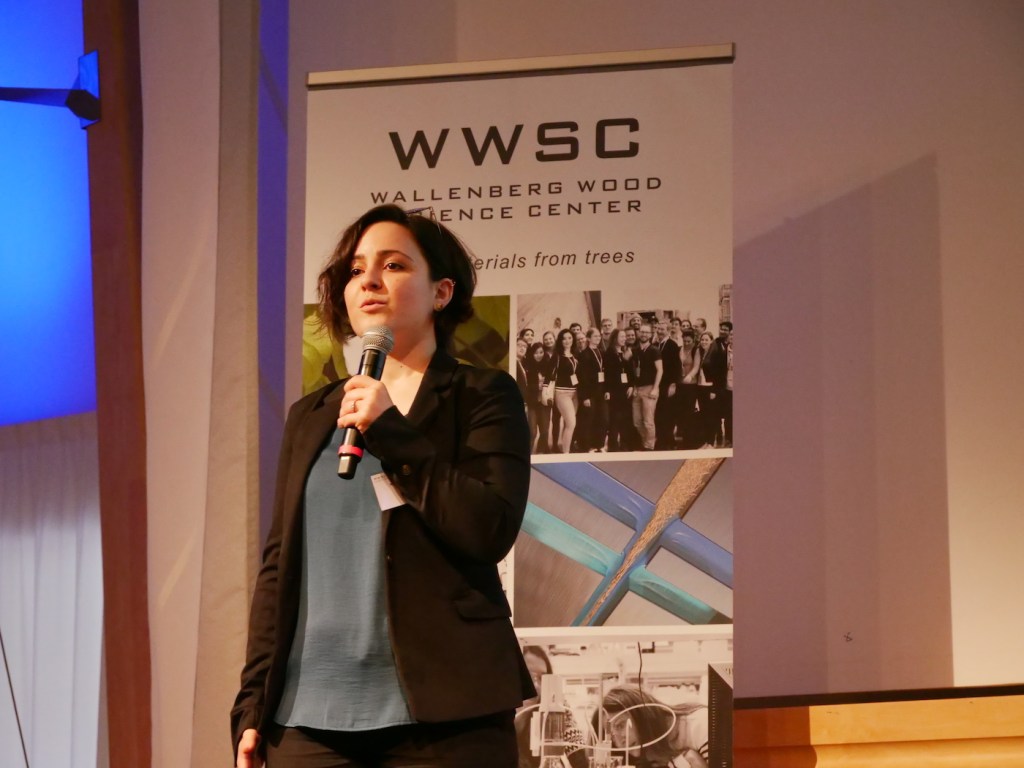
Ioanna Sapouna is a PhD student in our group. She has been working within a national network called the Wallenberg Wood Science Centre (WWSC), and is part of the WWSC PhD Academy. Ioanna defended her doctoral thesis at KTH Royal Institute of Technology on June 14th 2023.

Hi Ioanna! Huge congratulations on the completion of your PhD, it is such an achievement! How do you feel now that you have cleared this milestone?
Thank you so much Lauren! It took me a while to realise yet that it’s over! I am glad I made it and I am trying to digest the fact of graduating as the days pass.

For those who are not working in the Swedish university system, can you tell us what happened on the day of your PhD defence?
It was a great day! In the morning, the defence started with a presentation from my opponent Prof. Claudia Crestini, who gave a short presentation about my work and showed how it fits in the lignin chemistry field. After that, I presented my work. This was followed by a discussion with my opponent on my thesis work – I must say, I enjoyed that part. The faculty committee asked questions next. I was honoured by having Assistant Prof. Mika Sipponen, Prof. Ola Wallberg, and Prof. Monika Österberg as my committee members. That was the public part of the defence. After that, the committee privately discussed and decided that I passed the exam. The announcement was held at the WWSC workspace, in front of my colleagues, friends, and family who were there with me. Quite an emotional moment! After the defence I had lunch with the committee and a party in the evening. It was a real celebration! 

We always try to make sure that dissertation events are meticulously planned, but was there anything that surprised you on the day?
In the PhD defences at KTH, there is always someone from IT helping set up the webinar, making sure the electronics are working, and so on. All worked fine up to the moment the presentations started! PowerPoint suddenly stopped changing slides during Prof. Crestini’s presentation and my pointer stopped working during my presentation. That was a bit stressful in the moment but thinking about it now it might have actually helped dissipate the tension. Also, at some point the lights randomly turned off, probably because of a timer or something like that, and one of my committee members said “Oops! Time’s up!” That was funny and helped me relax a bit.

Let’s talk about the research you performed for your PhD. What was the overall goal of your thesis?
The overall goal was to explore fundamental aspects of native lignin, such as its structure, polymerization and interactions with the other components of the plant cell wall. I’ve written about some of the published work that went into the thesis in blog posts here on this website 🙂

Do you feel like you answered all the research questions that you wanted to address? Or are there some aspects of lignin structure and synthesis that still really make you curious?
Many of the topics I explored have been controversial for several decades now. We tried to come closer to answering some of the bigger questions and I believe our work did make a small contribution towards that goal. Of course, there are more aspects to be explored and questions to be answered, and if I could continue this research for four more years, I would still have a lot to do! However, I am happy with the work we have done and everything I learnt these past years.

What was the most surprising thing you found out during your research these past four years?
It is quite common in the field to talk about lignin heterogeneity and how the structure of the polymer is very different from plant to plant, and even between different parts of the same plant. This is true. For example, if you are trying to find repeating units in lignin or a specific sequence in its building blocks, it’s not going to happen. But, at the end of the day, “lignin is just lignin”. Its precise structure and properties might depend on different parameters but when we analyse it we are considering averages of the different structures we find in the plant, so the impact of extraction for example turns out not to be that pronounced. It might seem logical now, but it was a big moment of realisation for me looking at all of my data and expecting to see bigger differences between samples.

PhD students at KTH need to take a lot of courses during their programme, and you also took part in the PhD Academy Programme offered by the Wallenberg Wood Science Centre, which financed your work. Was it ever challenging to balance your time between research and courses? If so, how did you manage that?
Absolutely it was! (laughing) You can plan your experiments and be very well organised but one of the most important things my studies taught me was that experiments can really go sideways. When this happens, which is absolutely fine by the way, you can wave your schedule goodbye! In these situations, it was really hard to also handle all my other responsibilities, for example maintaining certain lab equipment, or attending the courses and workshops of the Academy. But you learn something from every situation. Prioritisation is the only way to manage. I needed a lot of help with this, especially in the beginning, but I think I got better at it. Also, getting used to budgeting time for things to go wrong helped me! It might sound strange or even pessimistic, but many times I struggled with an overloaded schedule and having ‘spare’ time allotted to repeat failed experiments really helped.

And what do you think is the most important skill you have gained during your doctoral studies?
As I had no prior experience with lignin chemistry before my PhD, each project was a step out of my comfort zone. Due to certain events along the way, there were times where I felt I was stepping further and further away. If I have to choose a favourite skill, I would say NMR analysis. I absolutely loved working with this technique. But a PhD is not only about technical skills. For example, I also learnt how to adapt to different situations and overcome difficulties that I couldn’t even imagine before I started. 

Is there anything you will miss about this period in your life?
This was the last time I held the title “student”. I will continue learning throughout my career, but the “official” part is over. If you think that for the largest part of my life I’ve been studying, it is a big change. I am not sure I will miss it, but definitely it will take some time to adjust. 

If you were able to go back in time and tell yourself something to make you better prepared for the PhD journey, what do you think it would be?
“It is OK to fail”. This was the most important lesson of my doctoral studies. Experiments occasionally fail, planning doesn’t always work out the way you thought – not to mention about bigger changes and situations completely out of your control. Starting my PhD with the mentality that things don’t always go the way you thought they would be could have made things a bit easier to handle.

Ok, let’s look to the future now. It has been a couple of months since you defended your PhD, so what are your next steps?
I would love to continue my journey in research and preferably continue working with lignin. And I just had a baby! So after maternity leave, I plan to do a post-doc in the lignin field and I would like to focus on material applications. I feel that during my PhD I got a broad, theoretical background on lignin and now I want to apply this knowledge and do something more tangible.

What are you looking forward to the most?
There have been so many changes in my personal and professional life the past few months that I don’t even know where to start! The coming months will for sure be exciting and I want to be open to all the different experiences coming up.

Finally, do you have any words of advice for future PhD students at KTH or other universities?
I’ve heard this before from another PhD student and I truly felt it during my studies: If you are not certain about pursuing a PhD, don’t do it. There are ups and downs throughout these years that will challenge you in every way possible. I don’t think I would have made it if I didn’t really want this. But if you decide to go for it, then try to experience all the high highs and the low lows because four years go by surprisingly fast!

Thank you Ioanna for the interview, and for all the hard work over the past few years. We will miss you at KTH, but we know you are moving on to bigger and better things – we can’t wait to see what you can achieve!!

Welcome interview: PhD student Pakinee Thianheng

Pakinee Thianheng is a PhD student in our group. She started at KTH in June of 2023. Lauren McKee is her main supervisor, and she is co-supervised by He Li at KTH and Johan Larsbrink at Chalmers University, Gothenburg. She will be working within a national network called the Wallenberg Wood Science Centre, and is part of the WWSC PhD Academy.

Hi Pakinee, and welcome to Sweden! Congratulations on starting your PhD programme at KTH! You arrived in Stockholm on June 1st – how does it feel to be here so far?
Thank you for your warm welcome! Since I have been living in Stockholm, Sweden for almost two months, I have definitely loved it here. The weather has been pretty good. Maybe, it’s because I luckily arrived here in summer. The city looks lively with people going out and I also enjoy going out to explore the city too. 

What has been the biggest challenge since you arrived in Sweden? Have you experienced any big culture shock so far?
I think the biggest challenge for me, right now, would be how to quickly get a bank account and a BankID (the online/app system we use in Sweden for pretty much everything official and semi-official). Can you believe it’s been almost two months since I got here and I still don’t have one? It’s making my life a real hassle, you know? Everything in Sweden seems to require some online process or app, and without that BankID, I feel like I’m missing out on so much. I gotta say, dealing with this has been a big culture shock for me so far, admin seems very slow, especially during summer.

How do you feel about starting your PhD? What are you most looking forward to?
Although I have just started my PhD, I already feel so comfortable in the group. Seriously, everyone is super nice to me!  And the best part is my supervisor is totally chill and approachable. So, I think I have a great start here and I’m pumped with all this positive energy to keep pushing through my PhD. Moreover, it’s not just about the awesome colleagues and the kind supervisor – I’m also part of the WWSC network! That means I’ll never feel alone during my PhD time. With both KTH and WWSC backing me up, I am looking forward to both academic and non-academic activities they have to offer. It’s going to be a wild ride, and I know it’s going to be so worth it. This whole experience will be incredibly rewarding.

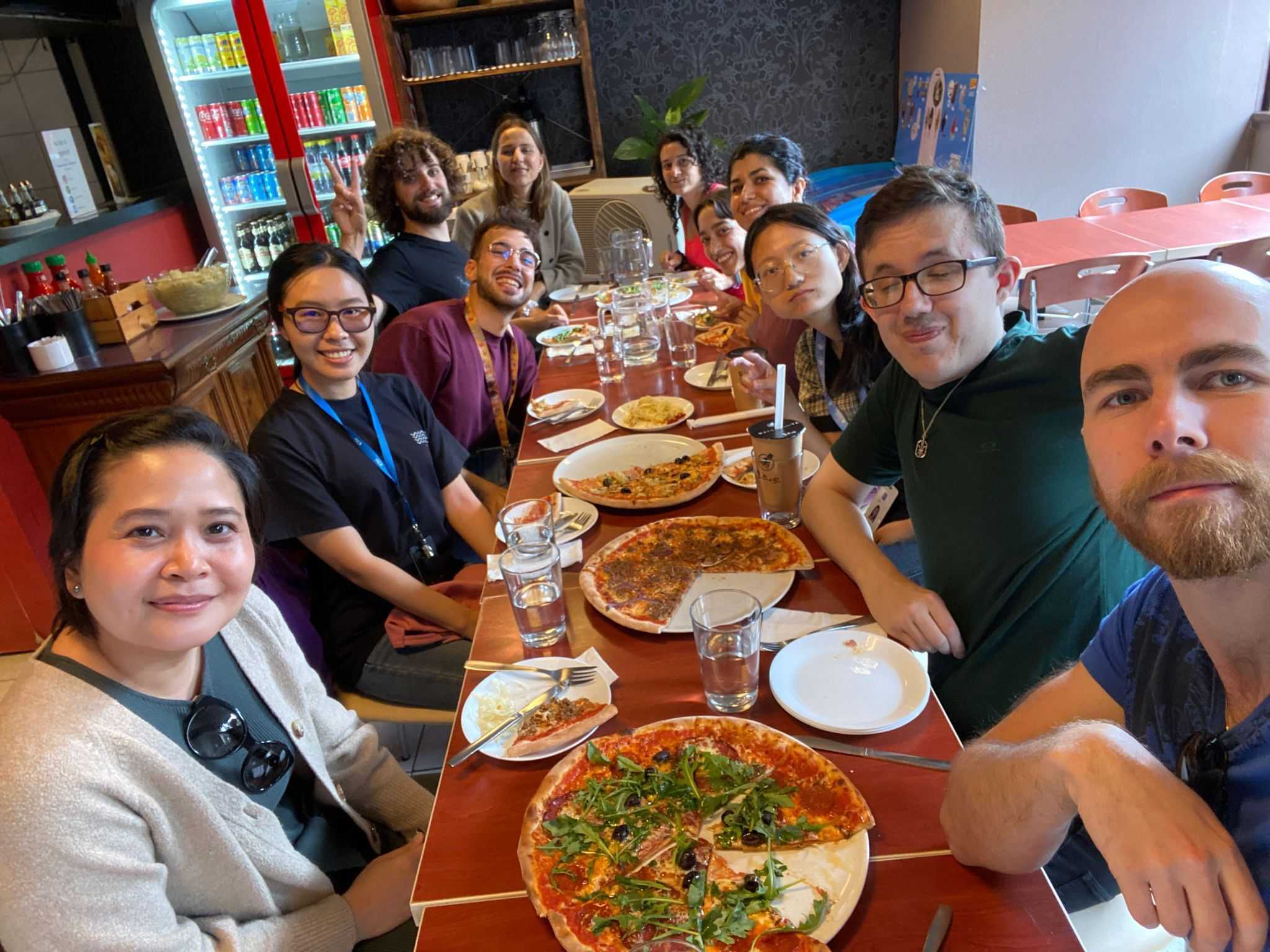
Pakinee having lunch with other members of the KTH DIvision of Glycoscience this summer.

Is there anything you are particularly nervous about?
As an easy-getting nervous person, yes! I’m really nervous when I need to talk to new people. It’s because I don’t know how to react and I like to observe how they are before I will be myself around them. So, this makes me a little bit slow in making new friends. And don’t even get me started on when all eyes are on me! Like, giving a presentation? Total nightmare! My nerves go through the roof. But hey, I’m working on it. I want to be more confident, especially now that I’m diving into this PhD thing. It’s a chance to grow and build up that self-assurance.

You are performing your PhD within the Wallenberg Wood Science Centre. Tell us about the research project you are going to be working on.
My research project is about “Discovery and application of microbes and enzymes to recycle and add value to pulp and paper sludge.” The pulp and paper industry has a huge problem due to the use of metals strong chemicals in its production processes – it leads to toxic sludge waste! And you know what they do with a lot of this waste? They have to just store it or dump it in landfills, causing serious environmental damage. Not cool at all! So, my mission is to find a sustainable way to clean up this mess.

With my background in microbiology and biochemistry, I’m excited to introduce the real heroes of this story: microorganisms! These tiny creatures are like a superhero team, and they have a special power – enzymes. These amazing enzymes can break down organic materials, such as cellulose and starch found in the sludge, into valuable sugars like glucose. And guess what we can do with that glucose? Convert it into a green alternative energy carrier – ethanol! How cool is that?

To track down which of these tough microorganisms are the best at their job and understand their secrets, I’ll be using high-throughput sequencing technology in my study. Once I identify these powerhouse species, I plan to apply them as biological tools to tackle sludge waste like never before! I truly hope my project can make a real difference and contribute to a cleaner and more sustainable future.

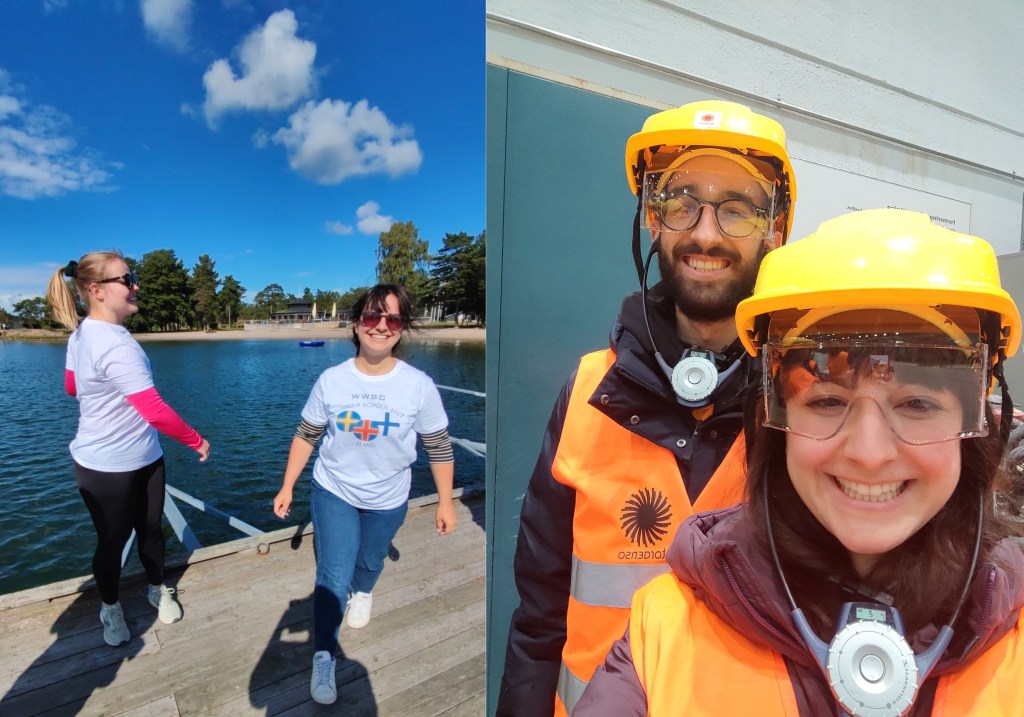
Pakinee in the lab and in the city. The summer nights in Stockholm are long, so it is a good time to explore after work!

Previously you have worked in laboratories in Thailand and Japan. What was the difference between working in those two places? And how do you think Sweden compares so far?
Alright, let me spill the beans about my work experiences in Japan, Thailand, and Sweden.

When I was in Japan, people were all about hard work and dedication. I was like, “Okay, I gotta keep up with these guys!” So, I put in some serious effort too. I tried my best to maintain a work-life balance and not work on weekends. But as you can guess, it wasn’t easy to avoid it, hahaha! And academic events, they were serious business. I had to dress very formal and rock the black outfit to show some respect. But you know what? One thing I liked about the Japanese work culture was how everyone respected the rules. They were responsible people.

After working in Japan for two years, I moved to Thailand and it had a whole different vibe. Work-life balance was much better there. My Thai supervisor was cool with flexible working hours, which was great! Actually, not only time can be flexible, but also rules. Sometimes it is good if the rules can be flexible, but sometimes it’s not. It sounds great that something can be flexible, right? Well, don’t hurry to judge. A coin has two sides. I often got stressed in Thailand from overloaded work, traffic jams, and the darn air pollution, which I’m allergic to. I spent around four hours a day on the road to go to work and come back home. Those things were pretty tough for me.

But now, I’m in Sweden, and it’s like a whole new world! Work-life balance is great, the environment is good, and the work atmosphere is super chilled. No need to rush in the mornings because public transport is so convenient. And guess what? I don’t feel all exhausted after work either. This place is a real blessing for my well-being and mental health. I hope this positive vibe sticks with me throughout my entire PhD journey here!

Pakinee takes a break from the lab. A great thing about Stockholm is that, even in the city, you are never very far from water, rocks, and trees.

A few short questions to get to know you…
What is your favourite kind of food? Steak and salad.
Do you prefer to read books or watch movies? Movies.
What is your favourite animal? Absolutely Cat!!! I have been a cat person since I was young.
What is the best advice you’ve ever received? Don’t compare yourself to others too much, but focus instead on comparing yourself to your past self.
What skill would you most like to learn? Swedish language.

Thank you Pakinee for telling us about yourself – we are happy to have you on the team!! 

Half-time review seminar – thoughts on native lignin and personal development

In the beginning of a PhD student employment, an introductory meeting takes place where the student is introduced to the director of studies, the PhD administrator, and the HR team. During this meeting, I felt overwhelmed by all the information I was receiving but also excited about my new start. The concept of the “half-time review seminar” was explained to me back then and it seemed to be so far in the future. Two quick years later, the moment to have my seminar has come and it feels that my introductory meeting was only a few days ago.

The half-time review seminar is a requirement for doctoral students employed at KTH. The student presents an overview of the research so far, participation at conferences, courses completed, workshops attended, and so on. An important part of the seminar is the plan for future work. The evaluators and director of studies need to see that the student not only has been making progress in the first years but also that the progress will continue in the following years of the doctoral studies. Furthermore, the seminar is a great opportunity to evaluate if the workload of the student is bearable and if adaptations to the plan are required.

And just like that I realized that I am now half-way through my doctoral studies. That realization shocked me, as it means that two years from now I will give up the title “student”. This title followed me for about 22 years and soon I will no longer be associated with it. No more ECTS will be required of me, and my continuous learning will be driven solely by my own curiosity. Until now I always had a plan and knew what lay ahead. At least I had a pretty good idea. However, this next chapter of my life comes closer every day, as the defence of my PhD will signify the end of my current path of being a student. In front of me there is a sea of endless possibilities. Should I continue with a career in the academy? This work environment is very demanding but somehow also familiar. A researcher’s position in industry sounds intriguing too. Or should I start something of my own? After all I live in Sweden, an ideal country to found a start-up. The fact that I have so many options is proof of the great teachers and mentors I had all these years and especially during the past six months since I joined the CAZyme group. The support and bonding in this group is the perfect ground to grow, be creative, and dare to develop as a researcher.


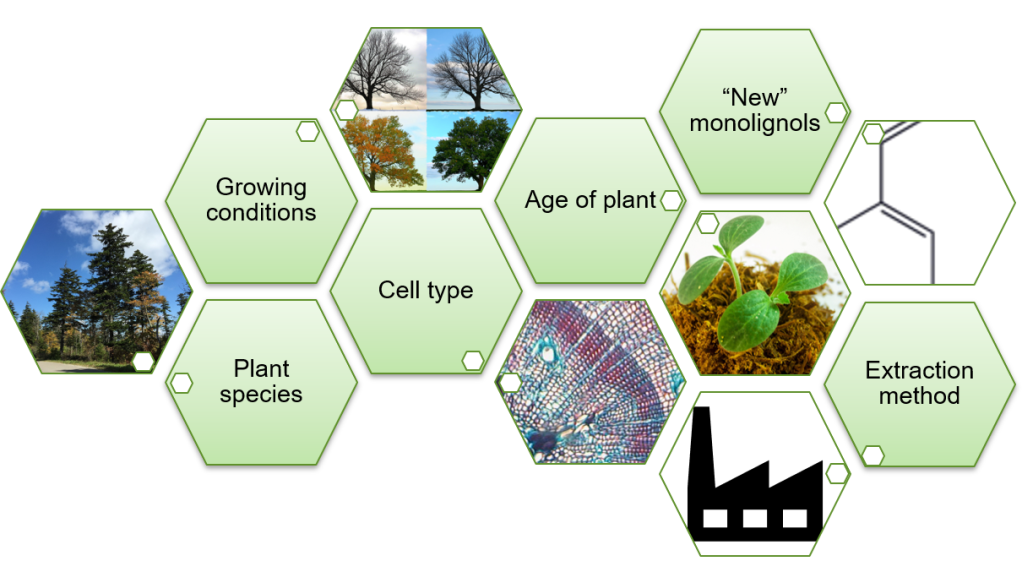
A couple of weeks ago I faced my first public evaluation, during my half-time review seminar. I started my presentation nervously, with an introduction to the subject of my doctoral studies: native (i.e. natural, unmodified) lignin. Native lignin is an intriguing material, absolutely ideal to fuel my curiosity as a soon-to-be independent researcher. I initially decided to apply for this particular PhD project mainly because I was fascinated by the fact that gaps in fundamental knowledge still exist for the second most abundant biopolymer on Earth! Lignin is a major component of plants and yet so far, we have failed to quite grasp its native structure and many aspects of its biosynthesis. There are several factors that affect the structure of lignin, summarised in the image below. The plant species, cell type, and plant age are only a few. From my point of view, the complexity of the biomolecule’s nature is linked to one of its biological roles as a response to stress. By definition, trying to perform reproducible research on a molecule that can be provoked as the defence mechanism of a living organism cannot be an easy task! Sometimes I like to think of native lignin like a property in quantum mechanics; when we take a measurement the wavefunction collapses at the resulting value. The measurement method we choose to use has a specific influence on what is observed, and the two are inextricably linked. Similarly, as an example, an extraction protocol that is optimized to obtain high amounts of a specific bond within the lignin polymer might fail to give high overall lignin yields, meaning that only a fraction of total lignin is studied. This irony is inherent in classical methods of lignin analysis. We cannot avoid affecting the structure and chemical properties of a molecule that forms via radical polymerization, especially one that can rearrange its bond structure to defend the plant. The different extraction methods one can use have different yields and show variations in relative amounts of the lignin interunit linkages. The classical methods that are typically used to produce standard lignins are simply no longer good enough to answer the remaining fundamental biological questions about lignin. This is what motivates me in my doctoral work.

Lots of different factors can affect the structure and properties of lignin, including all of the natural phenomena mentioned here as well as the method we use to extract it for analysis. This last factor is the focus of much of my current research – I want to understand how we change lignin when we decide to study it! Figure made by Ioanna Sapouna using stock image photos.

After my presentation at the half-time meeting, the evaluators asked questions about my studies in general and about my research in specifics. My two evaluators were not from the same field, which gave me the opportunity to discuss lignin from different perspectives. The first one was an expert in extraction and valorisation of technical lignins. The discussion with her was focused on the experimental part of our previous work on extracting lignin, details like the yields and standards used for comparing our results to previous work. I was relieved to be able to easily answer these questions, and felt secure and confident because I performed the experimental work myself. The second evaluator was an expert in biotechnology. Being a chemist myself, I was nervous about being challenged on the biotech implications of lignin. However, during the discussion with him I had the opportunity and pleasure to express my thoughts about the versatility of lignin in the cell wall and the effect that has on its extractability. I couldn’t help but notice my personal development during these past two years. Before I started my studies I only had some basic knowledge about this molecule and here I am, two years later, developing my own ideas and hypotheses on its native aspects.

To be able to defend these thoughts and ideas is really a privilege gained by working with Lauren. It takes a Teacher to build a student’s confidence and help her move towards being an independent researcher, and Lauren surely is. Unfortunately, women in academia are still underrepresented and the importance of having strong female role models is greater than ever. I consider myself lucky to work in such an environment and to be inspired by strong women who thrive in science. After my half-time seminar I feel a stronger connection to my work and its significance to society. I aspire to complete my studies and be of service to the scientific community as a researcher and as a person.