Category Archives: Recruitment

Welcome interview: PhD student Carlos Huertas Diaz

Carlos Huertas Diaz is a PhD student in our group. He started at KTH in September of 2025, and his work is mostly funded by the Swedish Research Council Vetenskapsrådet. Lauren McKee is his main supervisor, and he is co-supervised by Francisco Vilaplana at KTH and Johan Larsbrink at Chalmers University, Gothenburg.

Hi Carlos, and welcome to Stockholm! Congratulations on starting your PhD programme at KTH! You finished your Master’s degree just before summer and now you’re a doctoral student – how does it feel so far?

Hi Lauren! Thank you so much for this opportunity first of all. It feels unreal: I had literally just finished defending my Master’s Thesis and a few minutes later I got the offer of this PhD position, perfect timing! It’s a huge step in my career and a big challenge, but as we have talked about, I really want to keep learning and further researching, and this is just the perfect opportunity. So far I’ve felt super welcomed, the people at the Glycoscience Division feel like family already and this creates such a nice working environment where I can totally be myself.

What has been the biggest challenge or the most unexpected thing since you started at KTH?

Honestly the most challenging part was finding an accommodation, since I had no clue that Stockholm had such a high demand for housing and you had to be registered for queues before. And now being an employee that is still also a student: that has been a big transition from only being a student, where this is a total new environment and with much more responsibilities and where the start point feels different from being in a class with many other students (where everyone is as lost as you), to sharing an office with people working on many different things (where everyone is still lost, but lost individually). However, it feels very enriching to get to know about all these new topics. 

What are you most looking forward to in the coming four years?

I am so ready to learn more and be able to develop myself as a researcher! I wanted to continue studying because I still feel I have the motivation and I would really like to implement this knowledge at the same time, so a PhD was just perfect for these characteristics. It will for sure be a great challenge and with ups and downs, but I really want to dive deeper in research and be able to join the scientific community. Apart from that, traveling and exploring different facilities and working environments is something I would really like to do and I believe it can be very fulfilling, where you can meet great scientists who shape you and teach you along the way! I’m looking forward to my first conference next spring, and I hope we can plan for at least one research visit for me somewhere.

And is there anything you are particularly nervous about?

I am a bit nervous about publishing and writing manuscripts, since it’s new for me and as a mandatory part of the PhD it’s something I have respect for. I see it as a complicated process, where I will give my best to do as great as possible. I thought that I would be nervous about teaching and supervising Master students, but now I am feeling quite optimistic and looking forward to it. I think it will be real fun.

You are working now in the Division of Glycoscience, and there’s a lot to learn about carbohydrates and how we analyse them! Tell us a bit about the research project you are going to be working on.

In this project we will be working on the discovery, characterization, engineering and the application of carbohydrate-active enzymes (CAZymes) of microbial origin. We are aiming to explore the diversity of these enzymes encoded by industrial and environmental microbes. The main goal is to understand their activities and stability, exploring their application for industrial processes. Many recent studies propose that non-catalytic appended accessory domains such as the carbohydrate binding module (CBM) can stabilize CAZymes, but this is not really confirmed or understood, so we will test these hypotheses. For this project we are aiming to understand these inter-domain interactions and the stabilizing effects on the CAZymes so that stable industrial biocatalysis can be achieved.

Your previous research experience was at Lund University and before that in Spain. What was the difference between working in those two places? And how do you think KTH compares so far?

In Spain I did my Bachelor’s Thesis at the Center of Molecular Biology Severo Ochoa (CBMSO) in Madrid under the supervision of Aurelio Hidalgo. Then in Lund, Javier Linares-Pastén supervised my Master’s Thesis in the Biotechnology Division of the Engineering Faculty (LTH) of Lund University. They were both amazing experiences where I could settle myself into research. The main differences I would say were the authorship scale, where in Spain the gap between students and researchers or principal investigators is greater than the one in Sweden, where I felt professors were more easily approachable and students have more freedom of creativity in their project. Moreover, in Lund the facilities of the Kemicentrum, where I was performing my thesis, were more updated than the ones in CBMSO, so of course it was more accessible where the most resources were present. Here at KTH I see it so far as very similar to Lund University, with a super friendly and uplifting environment, where I can see myself improving as a researcher with great facilities and infrastructure.
A few short questions to get to know you…
What is your favourite kind of food? Empanada (I think the translation would be meat pie).
Do you prefer to read books or watch movies?  Movies, but a good book is always better.
What is your favourite animal?   The galaxy frog.
What is the best advice you’ve ever received? I live with this quote in my mind “journey before destination” where someone added “but in company”.
What skill would you most like to learn?  Further understanding mass spectrometry or nuclear magnetic resonance would be very cool.

Thank you Carlos for telling us about yourself – we are so glad to have you join the team!!

Group photo with Carlos and the rest of Lauren’s team  at AlbaNova (Carlos: I love this picture!).

PhD position available: Stable enzyme technologies for a sustainable bioeconomy

Note: the application process for this position closed in April 2025.

In brief: We have a PhD position available in our group, ideally to start in the autumn of 2025. Email Lauren with questions. Full details below.

Scientific goals: This doctoral research project focuses on the discovery, characterisation, engineering, and application of carbohydrate-active enzymes of microbial origin. We aim to explore the diversity of enzymes encoded by industrial and environmental microbes. Our goal is to understand their activities and stability, to explore their application in industrial bioprocesses. This fundamental research project will involve molecular biology, biochemistry, structural biology, and enzyme engineering. In addition, structural analysis of carbohydrates will be required. There is scope for creativity in this project, which can touch on diverse bioprocesses related to food, fuel, materials, and waste management. You will work closely with researchers at the Division of Glycoscience, the Stockholm CAZyme Laboratory, Chalmers University (co-supervisor will be Assoc Prof Johan Larsbrink), industrial partners in Sweden, and international collaborators.

Where we work: KTH Royal Institute of Technology in Stockholm is one of Europe’s leading technical and engineering universities, as well as a key centre of intellectual talent and innovation. We are Sweden’s largest technical research and learning institution and home to students, researchers, and faculty from around the world. Our research and education covers a wide area including natural sciences and all branches of engineering, as well as architecture, industrial management, urban planning, history and philosophy. The Division of Glycoscience is a multi-disciplinary department focussed on solving environmental and industrial challenges relating to sustainable production and usage of renewable natural resources, as well as advancing fundamental knowledge of complex carbohydrates.

The broader context: This project is supported by a grant the Swedish Research Council Vetenskapsrådet and builds on recent work in our group looking at the stabilisation of carbohydrate active enzymes (CAZymes) by non-catalytic appended accessory domains. In recent years we have generated much fundamental knowledge that now needs to be synthesised in a broad study to test the activity and stability of a large number of enzymes, to test our hypotheses. Our hope is to come to a sound understanding of inter-domain interactions and stabilising effects in order to design new molecular biology tools for enzyme stabilisation. As stable biocatalysts are needed in a range of different industries, this can have relevance for a number of aspects of the sustainable bioeconomy. You will join new and existing collaborations with (inter)national groups and we will together plan research visits

Education and skills development: Within the experimental work, you will gain or deepen skills in molecular biology, enzyme characterisation, carbohydrate chemistry, and protein engineering. Alongside your research, you will take doctoral courses at KTH and other Swedish universities, including online learning, lectures, and short lab projects. In addition, you will receive formal training in scientific writing and data visualisation. As part of your research, we will help you to write funding proposals to access additional financial support for travel and experimentation, giving you an even broader range of experience in science communication. I will also encourage you to write semi-regular pieces for this blog and to use other online channels to communicate with the public about your research.

Responsibilities as a PhD student: Your primary responsibility will of course be to advance the research project and to complete sufficient doctoral-level courses to earn the 60 credits you need to graduate. Your supervisors will help you to make sure you achieve these goals on time. In addition, you will spend up to 10 % of your time on Division/Departmental duties such as being responsible for a piece of equipment in the lab. Finally, you will take part in teaching younger students. The details of teaching are decided once the PhD has begun and the amount of teaching you do will be balanced against your other roles, but typically you will do some combination of lab teaching in a course for 1 or 2 years, supervising 1 or 2 MSc thesis students, and supervising 1 or 2 groups of BSc thesis students.

Eligibility for the position: To be eligible for this position, you should have a Master of Science or Engineering degree or equivalent qualification in a relevant subject area such as biotechnology. You should have completed a practical research-based (wet lab) thesis project. Documented proof of experience in areas such as molecular biology, biochemistry, and enzyme characterisation is appreciated but not necessarily required. Please email Lauren (find my email address at my KTH profile page) if you have queries about your eligibility for the role.

How to apply: You can find further specific details about this position on the official advert, available at this link: apply here. Please note that applications can only be considered if they are made through the KTH application portal, linked at the bottom of the advert. Informal applications made by email will not be considered. However, you are welcome to email Lauren if you have questions or are curious about this position.

Post-doctoral position available: Defining the material properties of a fully bio-based hydrogel

Note: the application process for this position closed in October 2023.

Note: this is a scholarship position funded by the Carl Trygger Foundation. The successful applicant will be the direct recipient of a tax-free stipend. As such, for tax reasons, it is not possible for current or recent employees (i.e. PhD students or post-docs) of KTH Royal Institute of Technology to apply for this position. Sorry!! Please read the following in its entirety before getting in touch…

In brief: We have a post-doctoral position available in our group, with a start date of early 2024, focussed on hydrogel characterisation. Full details below. The position offered is for, at the most, two years. Email Lauren McKee with questions. To apply, send the following items to Lauren by email: a 2-page CV, a 2-page cover letter detailing your previous scientific work experience and your interest in this position, and contact information for at least two referees. Application deadline October 16th.

Scientific goals: We have developed a new method to produce hydrogels from polysaccharides that avoids the chemical synthesis and fossil-based polymers often used in current manufacture. Using small proteins that bind to specific carbohydrates, we can produce viscous formulations and stable hydrogels in mild conditions by cross-linking polysaccharides. This represents a sustainable route to biomaterials formation, promoting materials innovation and a transition to a circular economy.

A hydrogel is a cross-linked matrix of long polymer chains locked into place in a network structure that holds large amounts of water, and is highly absorbent. While the hydrogels used in many applications are still made using synthetic or fossil-derived polymers, manufacturers are increasingly searching for sustainable alternatives, and are turning to biological polymers as a viable alternative. Polysaccharides are an excellent choice, but there is often a need for chemical modification to induce cross-linking and gel formation. Our protein-mediated system avoids this problem.

We have come a long way in understanding the biochemical aspects of our system. To progress beyond this stage, our team of enzymologists and molecular biologists needs to be joined by an expert in materials science and polymer chemistry. This post-doctoral scholar will characterise our hydrogel and optimise our production process, with both material quality and process sustainability in mind, to develop specific product ideas that can be tested at lab scale. We recently installed an advanced HR-20 rheometer, so there will be an emphasis on rheology and viscometry, but a wide range of hydrogel characterisation techniques will be needed.

Where we work: KTH Royal Institute of Technology in Stockholm is one of Europe’s leading technical and engineering universities, as well as a key centre of intellectual talent and innovation. We are Sweden’s largest technical research and learning institution, home to students, researchers, and faculty from around the world. Our research and education cover a wide area including natural sciences and all branches of engineering, as well as architecture, industrial management, urban planning, history, and philosophy. The Division of Glycoscience is a multi-disciplinary department focussed on solving environmental and industrial challenges relating to sustainable production and usage of renewable natural resources, as well as advancing fundamental knowledge of complex carbohydrates.

Training and skills development: A position as a postdoctoral scholar is a time-limited qualified appointment focussing mainly on research, intended as a first career step after a doctoral dissertation. You will be invited to take part in the co-supervision of Master’s thesis students, gaining experience in the training of younger researchers. You will be using soft material characterisation skills gained during your doctoral studies, but you will also be encouraged to learn new analytical skills through collaboration or formal training courses. This position will also be a step up in independence, as you will be responsible for proposing appropriate experiments and developing protocols for our group.

Responsibilities as a post-doctoral scholar: You will bring experience in soft materials characterisation, and you will be expected to both suggest and perform the most suitable experiments to characterise the materials. Our goals are to understand the intrinsic properties and potential uses of our materials, and to benchmark them against other materials. You will be encouraged to identify relevant infrastructure at other laboratories in Stockholm/Sweden and to initiate collaborative contact with relevant groups. You will also be jointly responsible for maintenance and upkeep of our rheometry equipment, and to train other users of the machine.

Eligibility for the position: You must have a doctoral degree or equivalent qualification, obtained within the last three years prior to the application deadline. Relevant topics include polymer chemistry and materials science, though you must have experience of working with biological polymers such as proteins and/or polysaccharides. Some awareness and training in biochemistry is a merit. You should be skilled in the characterisation of soft materials such as hydrogels for diverse applications. You should have a strong understanding of sustainable development and its relevance for this field. You must have strong written and oral communication skills in the English language. You should have a good ability to work independently and as part of a team.

How to apply: Send the following items to Lauren by email: a 2-page CV, a 2-page cover letter detailing your previous scientific work experience and your interest in this position, and contact information for at least two referees. In your application, please describe the soft material characterisation skills and methodological knowledge you can bring to this project. Application deadline October 16th.

Welcome interview: PhD student Pakinee Thianheng

Pakinee Thianheng is a PhD student in our group. She started at KTH in June of 2023. Lauren McKee is her main supervisor, and she is co-supervised by He Li at KTH and Johan Larsbrink at Chalmers University, Gothenburg. She will be working within a national network called the Wallenberg Wood Science Centre, and is part of the WWSC PhD Academy.

Hi Pakinee, and welcome to Sweden! Congratulations on starting your PhD programme at KTH! You arrived in Stockholm on June 1st – how does it feel to be here so far?
Thank you for your warm welcome! Since I have been living in Stockholm, Sweden for almost two months, I have definitely loved it here. The weather has been pretty good. Maybe, it’s because I luckily arrived here in summer. The city looks lively with people going out and I also enjoy going out to explore the city too. 

What has been the biggest challenge since you arrived in Sweden? Have you experienced any big culture shock so far?
I think the biggest challenge for me, right now, would be how to quickly get a bank account and a BankID (the online/app system we use in Sweden for pretty much everything official and semi-official). Can you believe it’s been almost two months since I got here and I still don’t have one? It’s making my life a real hassle, you know? Everything in Sweden seems to require some online process or app, and without that BankID, I feel like I’m missing out on so much. I gotta say, dealing with this has been a big culture shock for me so far, admin seems very slow, especially during summer.

How do you feel about starting your PhD? What are you most looking forward to?
Although I have just started my PhD, I already feel so comfortable in the group. Seriously, everyone is super nice to me!  And the best part is my supervisor is totally chill and approachable. So, I think I have a great start here and I’m pumped with all this positive energy to keep pushing through my PhD. Moreover, it’s not just about the awesome colleagues and the kind supervisor – I’m also part of the WWSC network! That means I’ll never feel alone during my PhD time. With both KTH and WWSC backing me up, I am looking forward to both academic and non-academic activities they have to offer. It’s going to be a wild ride, and I know it’s going to be so worth it. This whole experience will be incredibly rewarding.

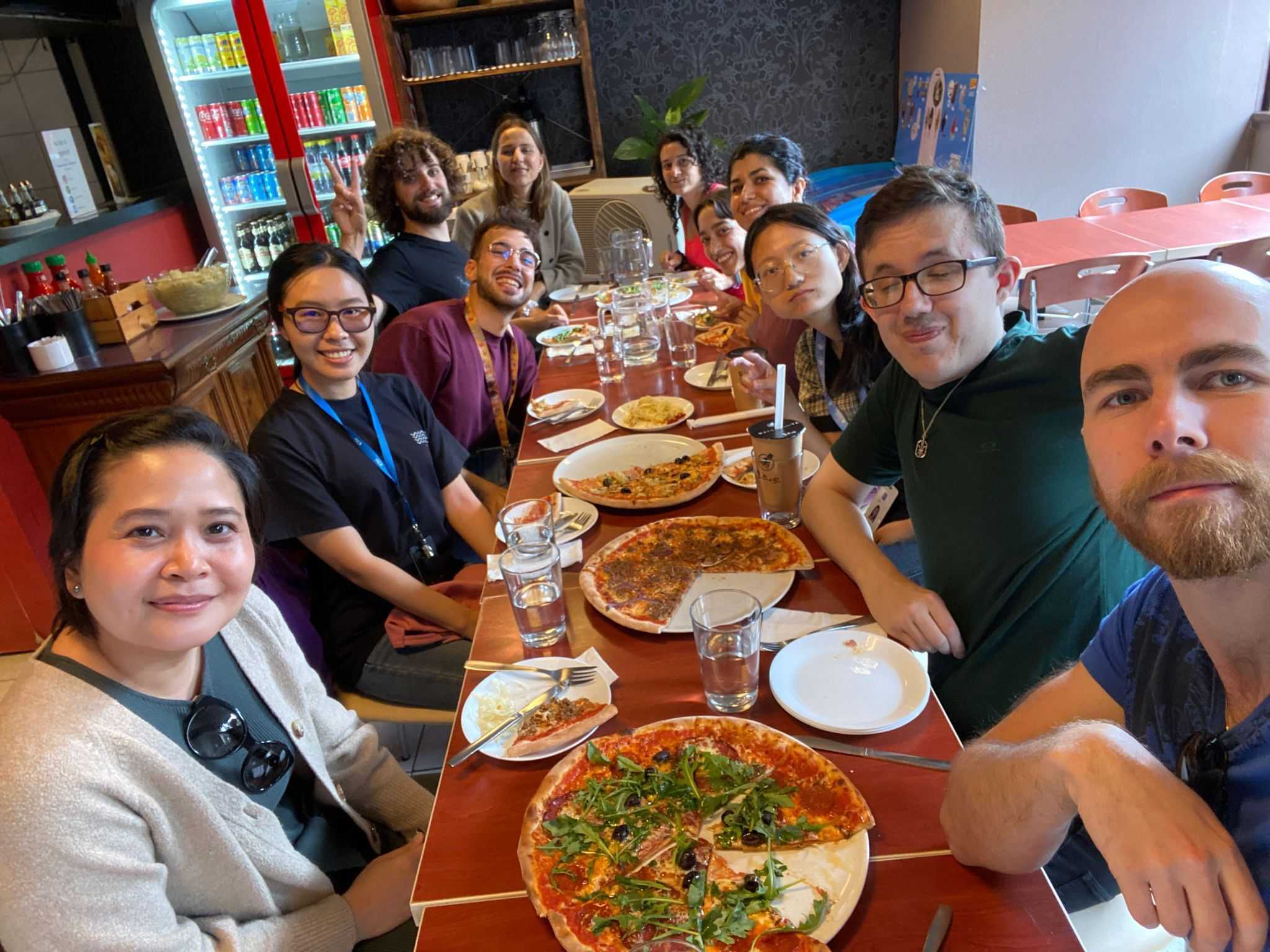
Pakinee having lunch with other members of the KTH DIvision of Glycoscience this summer.

Is there anything you are particularly nervous about?
As an easy-getting nervous person, yes! I’m really nervous when I need to talk to new people. It’s because I don’t know how to react and I like to observe how they are before I will be myself around them. So, this makes me a little bit slow in making new friends. And don’t even get me started on when all eyes are on me! Like, giving a presentation? Total nightmare! My nerves go through the roof. But hey, I’m working on it. I want to be more confident, especially now that I’m diving into this PhD thing. It’s a chance to grow and build up that self-assurance.

You are performing your PhD within the Wallenberg Wood Science Centre. Tell us about the research project you are going to be working on.
My research project is about “Discovery and application of microbes and enzymes to recycle and add value to pulp and paper sludge.” The pulp and paper industry has a huge problem due to the use of metals strong chemicals in its production processes – it leads to toxic sludge waste! And you know what they do with a lot of this waste? They have to just store it or dump it in landfills, causing serious environmental damage. Not cool at all! So, my mission is to find a sustainable way to clean up this mess.

With my background in microbiology and biochemistry, I’m excited to introduce the real heroes of this story: microorganisms! These tiny creatures are like a superhero team, and they have a special power – enzymes. These amazing enzymes can break down organic materials, such as cellulose and starch found in the sludge, into valuable sugars like glucose. And guess what we can do with that glucose? Convert it into a green alternative energy carrier – ethanol! How cool is that?

To track down which of these tough microorganisms are the best at their job and understand their secrets, I’ll be using high-throughput sequencing technology in my study. Once I identify these powerhouse species, I plan to apply them as biological tools to tackle sludge waste like never before! I truly hope my project can make a real difference and contribute to a cleaner and more sustainable future.

Pakinee in the lab and in the city. The summer nights in Stockholm are long, so it is a good time to explore after work!

Previously you have worked in laboratories in Thailand and Japan. What was the difference between working in those two places? And how do you think Sweden compares so far?
Alright, let me spill the beans about my work experiences in Japan, Thailand, and Sweden.

When I was in Japan, people were all about hard work and dedication. I was like, “Okay, I gotta keep up with these guys!” So, I put in some serious effort too. I tried my best to maintain a work-life balance and not work on weekends. But as you can guess, it wasn’t easy to avoid it, hahaha! And academic events, they were serious business. I had to dress very formal and rock the black outfit to show some respect. But you know what? One thing I liked about the Japanese work culture was how everyone respected the rules. They were responsible people.

After working in Japan for two years, I moved to Thailand and it had a whole different vibe. Work-life balance was much better there. My Thai supervisor was cool with flexible working hours, which was great! Actually, not only time can be flexible, but also rules. Sometimes it is good if the rules can be flexible, but sometimes it’s not. It sounds great that something can be flexible, right? Well, don’t hurry to judge. A coin has two sides. I often got stressed in Thailand from overloaded work, traffic jams, and the darn air pollution, which I’m allergic to. I spent around four hours a day on the road to go to work and come back home. Those things were pretty tough for me.

But now, I’m in Sweden, and it’s like a whole new world! Work-life balance is great, the environment is good, and the work atmosphere is super chilled. No need to rush in the mornings because public transport is so convenient. And guess what? I don’t feel all exhausted after work either. This place is a real blessing for my well-being and mental health. I hope this positive vibe sticks with me throughout my entire PhD journey here!

Pakinee takes a break from the lab. A great thing about Stockholm is that, even in the city, you are never very far from water, rocks, and trees.

A few short questions to get to know you…
What is your favourite kind of food? Steak and salad.
Do you prefer to read books or watch movies? Movies.
What is your favourite animal? Absolutely Cat!!! I have been a cat person since I was young.
What is the best advice you’ve ever received? Don’t compare yourself to others too much, but focus instead on comparing yourself to your past self.
What skill would you most like to learn? Swedish language.

Thank you Pakinee for telling us about yourself – we are happy to have you on the team!! 

PhD position available: Sustainable biotechnology to circularise forestry waste sludge

Note: the application process for this position closed in October 2022.

In brief: We have a PhD position available in our group, ideally to start in the spring of 2023. Email Lauren with questions. Full details below. You must apply at this link: apply here.

Scientific goals: Thousands of tonnes of sludge waste are produced each year at pulp and paper mills, and we aim to find new ways to recover components from this waste. The sludge contains valuable organic materials like starch, cellulose, and lignin, but it is heavily contaminated by metals and minerals that inhibit recycling. Most sludge is therefore sent to landfill. In this 4-year PhD project, we will use isolation techniques and DNA sequencing to identify the microbial species that thrive in this harsh industrial ecosystem, and use advanced “omics” methods to reveal the enzymes used in sludge breakdown. We will characterise these enzymes to create new precision tools for the forestry biorefinery, and to clean up the sludge by removing organic matter (leaving large amounts of recoverable metals, particularly aluminium). This project will advance fundamental knowledge and reduce industrial waste, helping to move the industry towards a more sustainable and circular model. You will be based at the KTH Division of Glycoscience, and your main supervisor will be Lauren McKee. You will collaborate closely with researchers at Chalmers University of Technology in the department of Industrial Biotechnology, as you will be co-supervised by Johan Larsbrink.

Where we work: KTH Royal Institute of Technology in Stockholm is one of Europe’s leading technical and engineering universities, as well as a key centre of intellectual talent and innovation. We are Sweden’s largest technical research and learning institution and home to students, researchers, and faculty from around the world. Our research and education covers a wide area including natural sciences and all branches of engineering, as well as architecture, industrial management, urban planning, history and philosophy. The Division of Glycoscience is a multi-disciplinary department focussed on solving environmental and industrial challenges relating to sustainable production and usage of renewable natural resources, as well as advancing fundamental knowledge of complex carbohydrates.

The broader context: This project is funded by the Wallenberg Wood Science Centre. The WWSC is a research centre striving for scientific excellence, with a focus on new materials from trees. The centre creates knowledge and builds competence for an innovative and sustainable future value creation from forest raw materials. WWSC is a multidisciplinary collaboration between KTH, Chalmers, and Linköping University. The funding base is a donation from Knut and Alice Wallenberg Foundation, and the Swedish forest industry is supporting the WWSC via the national platform Treesearch. As members of the WWSC, you and your supervisors will be expected to attend the workshops that take place in the Stockholm and Gothenburg areas twice per year, where you will present updates on your research and network with colleagues. You will be invited to regular Treesearch events, giving you further chances to present about your work and get access to the national Treesearch infrastructure platform.

Education and skills development: You will perform your PhD within the scope of the WWSC Academy. As a WWSC PhD student, you will attend two week-long graduate schools per year. This programme gives you a broad and deep insight into diverse forest-related topics, and helps you build a community of students aiming towards similar goals on the same timeline as you. You will also get to visit industrial sites and areas of natural beauty around Sweden, helping you get to know the country and its landscape as well. To complement your academy training, you will take doctoral courses at KTH, including online learning, lectures, and short lab projects. In addition, you will receive formal training in scientific writing and data visualisation. As part of your research, we will help you to write funding proposals to access additional financial support for travel and experimentation, giving you an even broader range of experience in science communication. I will also encourage you to write semi-regular pieces for this blog and to use other online channels to communicate with the public about your research.

Responsibilities as a PhD student: Your primary responsibility will of course be to advance the research project and to complete sufficient doctoral-level courses to earn the 60 credits you need to graduate. Your supervisors will help you to make sure you achieve these goals on time. In addition, you will spend up to 10 % of your time on Division/Departmental duties such as being responsible for a piece of equipment in the lab. Finally, you will take part in teaching younger students. The details of teaching are decided once the PhD has begun and the amount of teaching you do will be balanced against your other roles, but typically you will do some combination of lab teaching in a course for 1 or 2 years, supervising 1 or 2 MSc thesis students, and supervising 1 or 2 groups of BSc thesis students.

Eligibility for the position: To be eligible for this position, you should have a Master of Science or Engineering degree or equivalent qualification in a relevant subject area such as biotechnology. You should have completed a practical research-based (wet lab) thesis project. Documented proof of experience in areas such as molecular biology, biochemistry, and enzyme characterisation is appreciated but not necessarily required. Please email Lauren (find my email address at my KTH profile page) if you have queries about your eligibility for the role.

How to apply: You can find further specific details about this positon on the official advert, available at this link: apply here. Please note: applications can only be considered if they are made through the KTH application portal, linked at the bottom of the advert. Informal applications made by email cannot be considered. However, you are welcome to email Lauren if you have questions or are curious about this position.