
Exploring the native pulp and paper sludge microbiome to inspire new biotechnologies for waste minimization. Thianheng P, Schroeter KL, Larsbrink J, McKee LS. Microbiology Spectrum (2026)
Being a successful PhD student is not only about being able to conduct hands-on experiments, but communication and sharing new knowledge to others is equally important. One of the most important ways to do this is through publishing scientific articles.
Until now, I was mostly familiar with research articles as a reader, and I had been a co-author on some papers before my PhD. This time, however, I had to write about my own research as the first author, which turns out to be a big task and a big responsibility. When reading other people’s papers, it often seems straightforward. They just described what they did, what they discovered, and how their findings compared with previous studies – easy! However, when it came to write my own manuscript, I realised it was far from easy. I had to spend a great deal of time organising my thoughts and figuring out how to communicate them clearly and effectively.
Here, I am proud to share my first research article, entitled “Exploring the native pulp and paper sludge microbiome to inspire new biotechnologies for waste minimisation”, published in the ASM journal Microbiology Spectrum. In general, research articles are written in an academic style. If you are not familiar with this field, you may find some sections difficult to follow, particularly those involving specialised concepts in biochemistry. Don’t worry! I would like to take this opportunity to explain my work once again in a more accessible language. I would like to highlight what my team and I did and the significance of the discoveries we made.
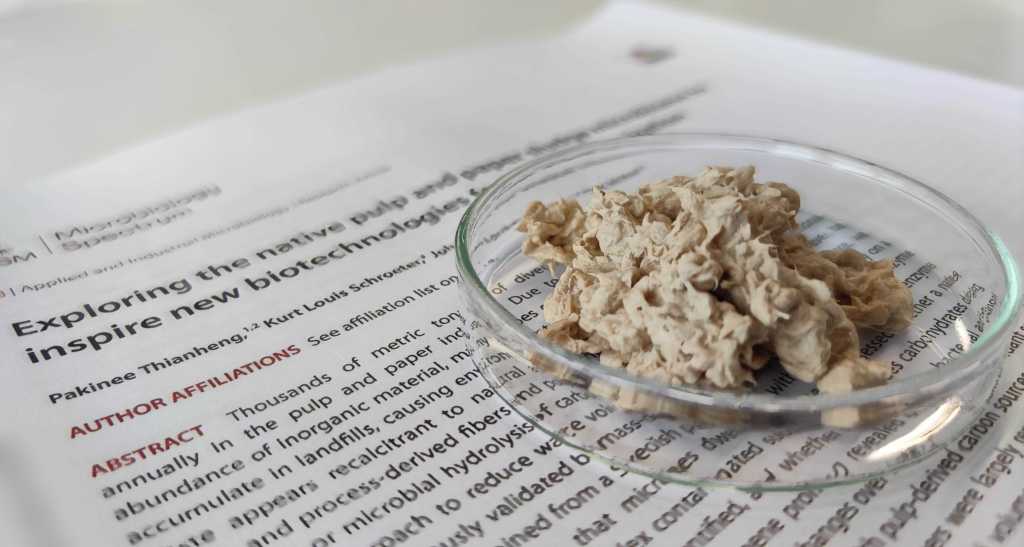
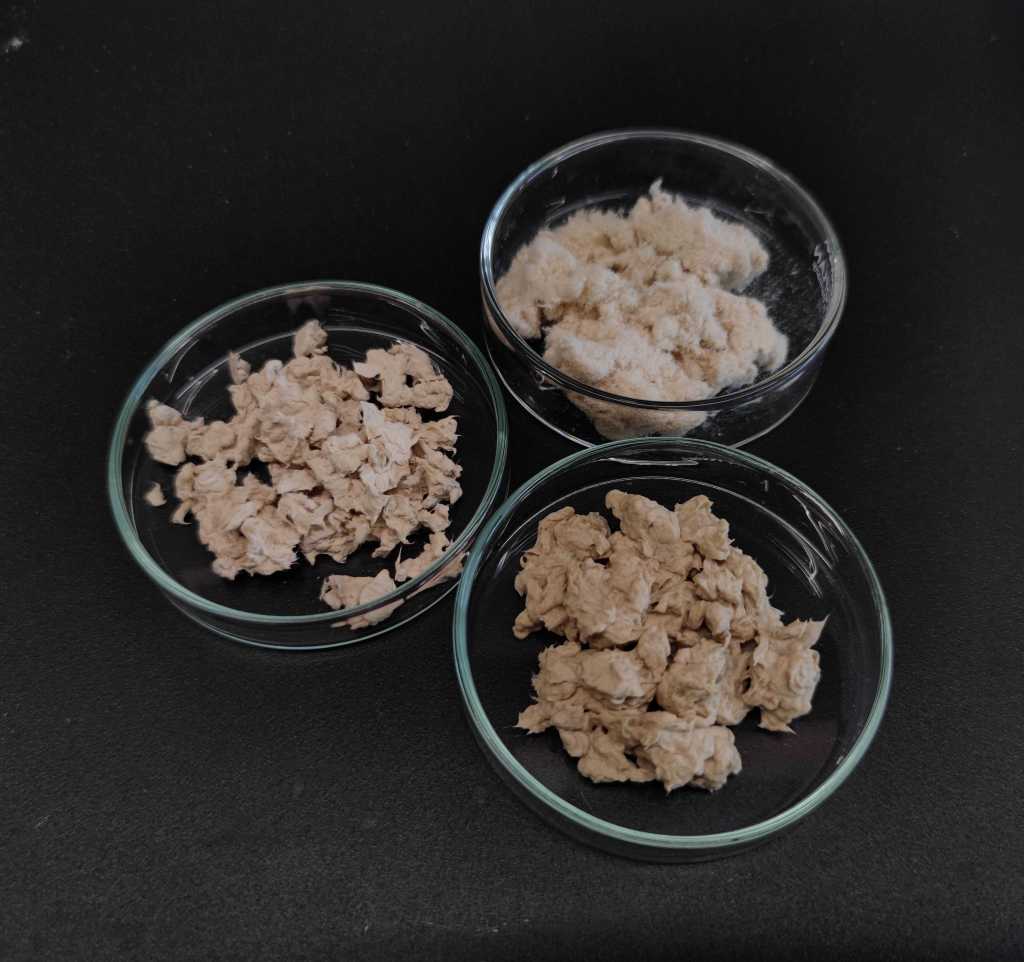

My PhD project focuses on waste minimisation for the pulp and paper industry. Every year, the pulp and paper industry in Sweden produces many thousands of tonnes of sludge waste. Most of this waste is sent to landfill. On the surface, this seems like a simple solution, just bury the waste underground and move on. In reality, however, sending sludge waste to landfill is not the best solution anymore.
This sludge contains leftover chemicals from paper and cardboard manufacturing, especially heavy metals such as iron and aluminium. When the waste is buried underground or left to stand out on the soil in big piles, these chemicals can slowly leak into groundwater and cause environmental damage. Moreover, sludge is persistent in nature. It breaks down very slowly in landfills. Consequently, the company needs to pay for monitoring metal leakage until the sludge will be completely decomposed. Furthermore, there is a tax on waste sent to landfills in Sweden. This means that the company needs to pay tax for sludge they sent to landfill. With many thousands of tonnes of this waste, the tax is not cheap. Overall, landfill is very expensive. Instead of spending money on landfill to store the waste underground, why don’t we find a better solution that actively reduces this waste, and invest in developing treatment technologies? As a PhD student with a microbiology and biochemistry background, I proposed using microbial treatment to break down sludge waste, which is a better solution than landfills. I hope that we can use microbes to reduce the volume of the waste, so that less needs to be stored
In nature, microorganisms exist as complex communities that interact with one another. This is well-studied in a lot of natural ecosystems, but man-made or human-influenced environments like industrial waste are not as well studied. In the samples we collected, using DNA sequencing, I discovered diverse bacterial and fungal communities were present in the sludge. However, those bacteria and fungi in sludge are obviously not highly active in degrading sludge under the storage conditions used by industry. To enhance their activity, I developed some simple enrichment strategies that stimulated their growth and metabolic functions. Once activated, these microorganisms began producing fibre-degrading enzymes. Enzymes are natural biological catalysts that break down complex materials into simpler compounds. In this case, the enzymes helped to degrade fibre components within the sludge. After fibre clean-up, the overall volume of sludge was reduced, quite significantly in some cases. If you imagine applying this idea at scale, this can result in the minimisation of sludge sent to landfills. In my article, you can find out what those bacteria and fungi were, how I was able to enhance them to grow in the metal-rich sludge, and how successfully I could remove the low-quality fibres.
Although many bacteria and fungi were enriched to be active, it is still a mystery what fibre-degrading enzymes they used. As we tested in the article, existing enzyme cocktails that are good at breaking down other kinds of biomass are not good at breaking down this particular sludge, so I believe that the enzymes in my sludge community might be quite special. In ongoing research, I am using metagenomics and metatranscriptomics to reveal what enzymes the microbes produced and secreted to break down the fibres. This discovery will be published in future articles during the next stage of my PhD. You can follow my future publications on my ResearchGate profile. I have been joined by some master’s students in the enzyme characterisation work, so this project has also given me a lot of supervision experience.
Finally, this writing experience has taught me that publishing a scientific article is not easy, especially for a first-time lead author. However, it is not impossible. It just requires time, effort, perseverance, and attention to details. After seeing my first article get accepted and published, it fills me with both happiness and pride to reflect on what I have accomplished. Moreover, it gives me confidence in my abilities as a researcher and inspired me to begin writing my next research paper, with the hope of contributing even more to the field in the future. Stay tuned!

